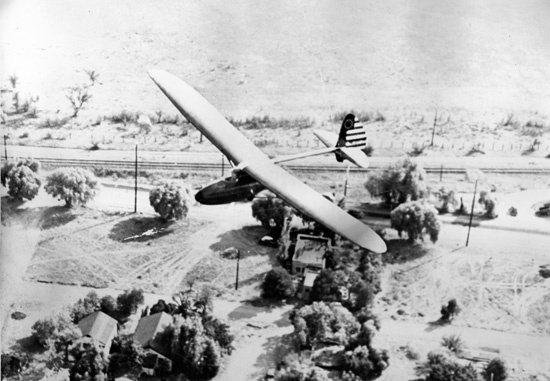
Bowlus Baby Albatross
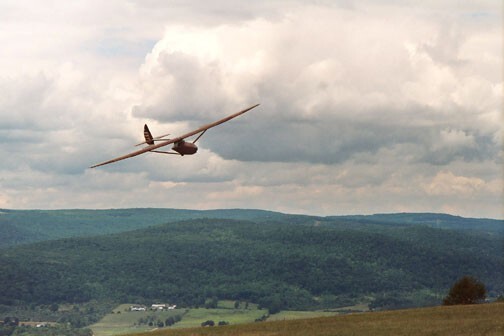
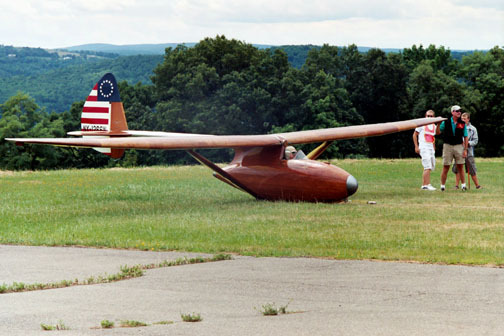
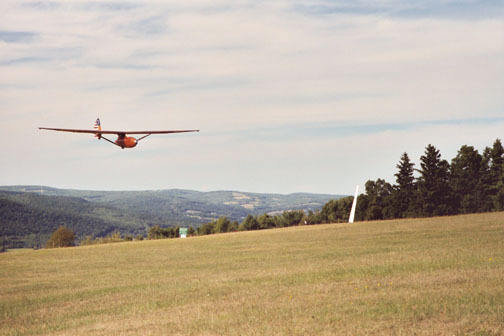
The Bowlus BA-100 Baby Albatross is an American highwing, strutbraced, open cockpit, pod-and-boom glider that was designed by Hawley Bowlus and introduced in 1938. Bowlus designed the Baby Albatross as an inexpensive glider during the Great Depression. The aircraft initially sold for $750 ready-to-fly, and $385 as a kit for amateur construction. Initially produced as a kit by Bowlus, the rights to the design were purchased in 1944 by Laister-Kauffmann, although that company went out of business before commencing production.
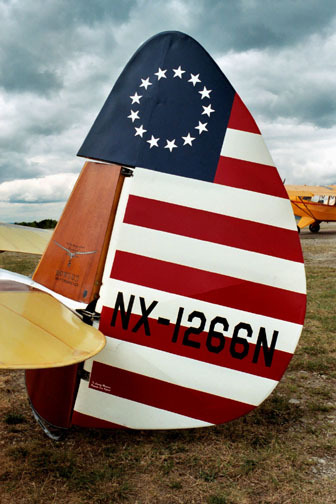
The BA-100 is of mixed construction. The wings and tail surfaces are of wooden structure, covered in aircraft fabric. The tailboom is made from a metal tube and the cockpit pod is of molded plywood. The aircraft features no glide-path control devices, although some were later modified with spoilers. The airfoil is a modified G fivethirtyfive section.
The production of the BA-100 totaled 156 kits delivered.
Many well known soaring pilots owned and flew the BA-100 as their first aircraft. These include Dick Johnson, Richard Schreder and Joe Lincoln. Despite its modest performance, the BA-100 has been flown on many flights of over 250 mi (402 km).
One BA-100 was modified by Schweizer Aircraft, replacing the plywood cockpit pod with a steel tube one.
The aircraft were known for their poor pitch handling characteristics. The famous aerodynamicist, Irv Culver, told Albatross owner, Jeff Byard, that the problem came from three sources. First, the rotation axis of the all flying horizontal tail was located at 35% chord instead of slightly in front of the aerodynamic center at 25% chord. Second, the horizontal tail rotation hinge had high friction. Third, the relatively soft pitch axis cable control system stored elastic energy reacting the friction in the tail hinge. As the pilot tried to input pitch controls into the unstable tail, the friction of the tailplane hinge prevented initial movement which then stored up energy in the control cables. The pilot then applied more force to get the desired reaction. Eventually, the high friction would break loose and the horizontal tail would move much farther than desired due to the higher than necessary force applied by the pilot and releasing the force in the control cables. The resulting overcontrol often caused Pilot Induced Oscillation and when near the ground would likely damage the aircraft. Culver instructed the owner to move the hinge axis forward to 24%, add a downspring to the pitch control, and liberally lubricate the hinge axis before each flight to reduce friction. According to Byard, the plane flies significantly better with the improvements.
As of September 2013 there were still 12 Baby Albatross on the US Federal Aviation Administration civil aircraft register.
The NSM Baby Albatross was received as a donation from Robert Burdick in 1985.
-
The National Soaring Museum
-
Harris Hill History
-
Bowlus Senior Albatross
-
Alby
-
Evans Trophy
-
Barographs
-
What is Gliding?
-
What is Soaring?
-
Ridge Soaring
-
Thermal Soaring
-
Schweizer 1-26
-
Baker-McMillen Cadet
-
Gross Sky Ghost
-
1937 Winch Truck
-
Chanute - Herring Glider
-
Shock Cord Launch
-
1902 Wright Glider Replica
-
Primary Glider
-
Ralph Barnaby Glider Launch from Dirigible
-
1935 Wolf
-
Olympia Meise
-
Midwest Utility Glider - MU-1
-
Franklin PS-2
-
Minimoa
-
BA-102 Two-Place Baby Albatross
-
Bowlus Baby Albatross
-
CG-4
-
LK-10A
-
BG-12BD
-
Ross-Johnson RJ-5
-
Bowlus Super Albatross
-
1911 Wright Glider Replica
-
Schleicher Ka6E
-
Slingsby Kirby Gull
-
Marske Genesis II
-
Zanonia
-
Orlik II
-
Glasflugel H-301 Libelle
-
HP 18
-
Flying Plank
-
Schweizer TG-3
-
Schweizer / SGP 1-1 Primary Glider
-
Schweizer 2-22A
-
Schweizer 1-35
-
Schweizer 1-7 Utility Glider