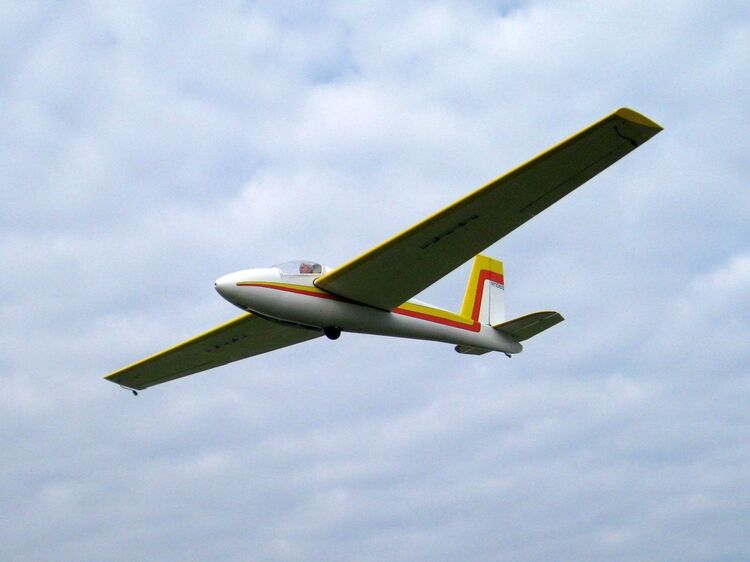
What is Gliding?
Simply put, “gliding” is moving through the air horizontally as well as downward – without some means of mechanical propulsion (propellers, rockets, etc.). A falling leaf, a rock – they all descend straight down in calm air. Wind may cause these things to drift sideways – but that’s not gliding. Gliding is made possible by two things: the given density of air (try riding a bike against a strong headwind) and having “flying surfaces” also known as “wings”. It’s the air flowing over (and under) these wings that provides the lift necessary to support a GLIDER in flight. To get the air flowing over your wings, you simply have the nose of your glider point downward (and keep it there) – it will do this automatically if the glider balanced correctly. The small balsa gliders sold in the Gift Shop have a steel clip on the nose – for balance. Take it off and the glider won’t fly! The first recorded design of a successful miniature glider goes back to the early days of the 19thcentury (1804 to be exact)! Early aviation experimenters saw gliding as a pathway to powered flight. Between 1900 and 1903, the Wright Brothers made over 1000 glider flights at Kitty Hawk. This process enabled them to perfect the aerodynamics of their designs and their methods of control. Their first successful powered flight in December of 1903 could never have been achieved without their gliding experiences.
-
The National Soaring Museum
-
Harris Hill History
-
Bowlus Senior Albatross
-
Alby
-
Evans Trophy
-
Barographs
-
What is Gliding?
-
What is Soaring?
-
Ridge Soaring
-
Thermal Soaring
-
Schweizer 1-26
-
Baker-McMillen Cadet
-
Gross Sky Ghost
-
1937 Winch Truck
-
Chanute - Herring Glider
-
Shock Cord Launch
-
1902 Wright Glider Replica
-
Primary Glider
-
Ralph Barnaby Glider Launch from Dirigible
-
1935 Wolf
-
Olympia Meise
-
Midwest Utility Glider - MU-1
-
Franklin PS-2
-
Minimoa
-
BA-102 Two-Place Baby Albatross
-
Bowlus Baby Albatross
-
CG-4
-
LK-10A
-
BG-12BD
-
Ross-Johnson RJ-5
-
Bowlus Super Albatross
-
1911 Wright Glider Replica
-
Schleicher Ka6E
-
Slingsby Kirby Gull
-
Marske Genesis II
-
Zanonia
-
Orlik II
-
Glasflugel H-301 Libelle
-
HP 18
-
Flying Plank
-
Schweizer TG-3
-
Schweizer / SGP 1-1 Primary Glider
-
Schweizer 2-22A
-
Schweizer 1-35
-
Schweizer 1-7 Utility Glider