Ridge Soaring
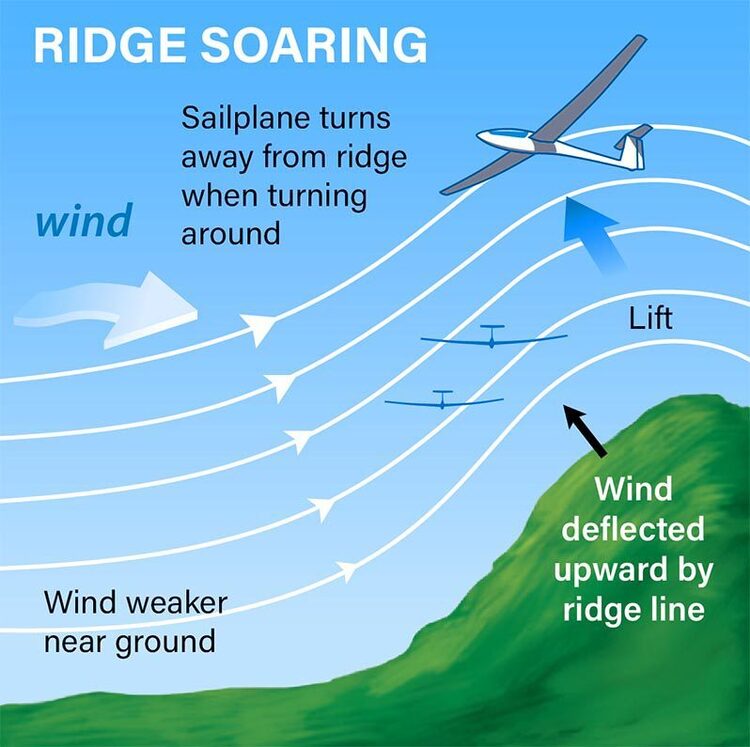
Ridge soaring – or “slope soaring” – is the earliest form of soaring - dating back to 1911 when Orville Wright stayed aloft for almost 10 minutes on the winds rising up the sloping sands at Kitty Hawk. Bear in mind that, if there were no wind, his glider wouldn’t “fall out of the sky”, he would simply glide down the slope and land after a very short time - probably measured in seconds. Air that is rising is what we call “lift”. In the case with slope soaring, wind is forced to follow the contours of the land – moving upward when it comes in contact with a slope or a ridge – which would be higher. A typical glider (or “sailplane”) descends through the air at 2 to 3 feet per second, while moving forward at around 50 mph. If the “lift” being provided by the slope is equal to the glider’s rate of descent, the glider will maintain altitude; if the lift exceeds the “sink rate”, the glider will actually climb. How high? If the ridge is 500 feet high, one can expect to attain that same height above the ridge – 500 feet.
In 1930, Elmira was chosen by the National Glider Association to be the official site for national soaring contests. The topography of the Shehmung Valley was considered ideal because of the numerous ridges – facing virtually all points of the compass. No matter which way the wind might be blowing, there was a ridge that would generate lift. The first official national soaring contest was held at Elmira in September of that year.
-
The National Soaring Museum
-
Harris Hill History
-
Bowlus Senior Albatross
-
Alby
-
Evans Trophy
-
Barographs
-
What is Gliding?
-
What is Soaring?
-
Ridge Soaring
-
Thermal Soaring
-
Schweizer 1-26
-
Baker-McMillen Cadet
-
Gross Sky Ghost
-
1937 Winch Truck
-
Chanute - Herring Glider
-
Shock Cord Launch
-
1902 Wright Glider Replica
-
Primary Glider
-
Ralph Barnaby Glider Launch from Dirigible
-
1935 Wolf
-
Olympia Meise
-
Midwest Utility Glider - MU-1
-
Franklin PS-2
-
Minimoa
-
BA-102 Two-Place Baby Albatross
-
Bowlus Baby Albatross
-
CG-4
-
LK-10A
-
BG-12BD
-
Ross-Johnson RJ-5
-
Bowlus Super Albatross
-
1911 Wright Glider Replica
-
Schleicher Ka6E
-
Slingsby Kirby Gull
-
Marske Genesis II
-
Zanonia
-
Orlik II
-
Glasflugel H-301 Libelle
-
HP 18
-
Flying Plank
-
Schweizer TG-3
-
Schweizer / SGP 1-1 Primary Glider
-
Schweizer 2-22A
-
Schweizer 1-35
-
Schweizer 1-7 Utility Glider