Gross Sky Ghost
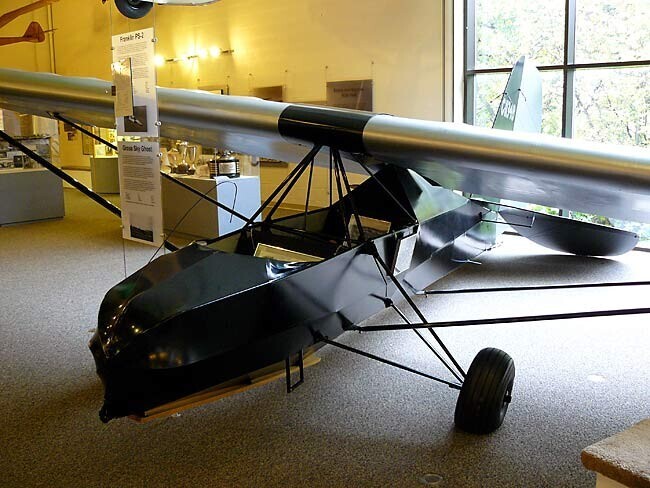
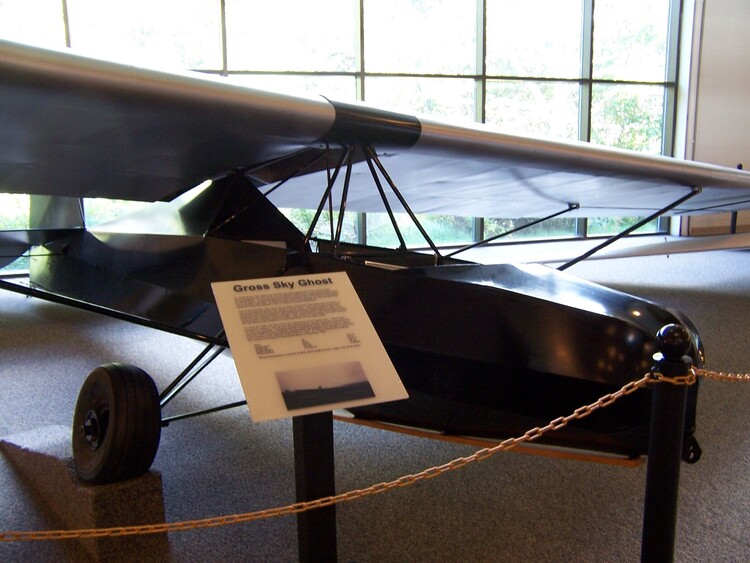
The Gross Sky Ghost is an American high-wing, strut-braced, two-seat glider that was designed by Frank Gross.
The Sky Ghost was Frank Gross's third glider design after the Baker-McMillen Cadet and the Akron Condor. The Sky Ghost was innovative for its era, in that it had tandem seating with dual controls. In the 1930s most glider flight training was accomplished by having a student fly short hops under supervision of an instructor on the ground.
The aircraft fuselage is made from welded steel tubing, with all surfaces covered in doped aircraft fabric covering. Its 43-foot wing is mounted above the rear seat and supported by parallel lift struts. The tail is cable-braced. The cockpit is open, without a windshield. The landing gear is a conventional arrangement for fixed wing powered aircraft, rather than the more common central wheel used on gliders. A wooden skid is also mounted on the fuselage center line. In addition to the main landing gear the aircraft has a tail skid and wing tip skids in the form of tubular loops.
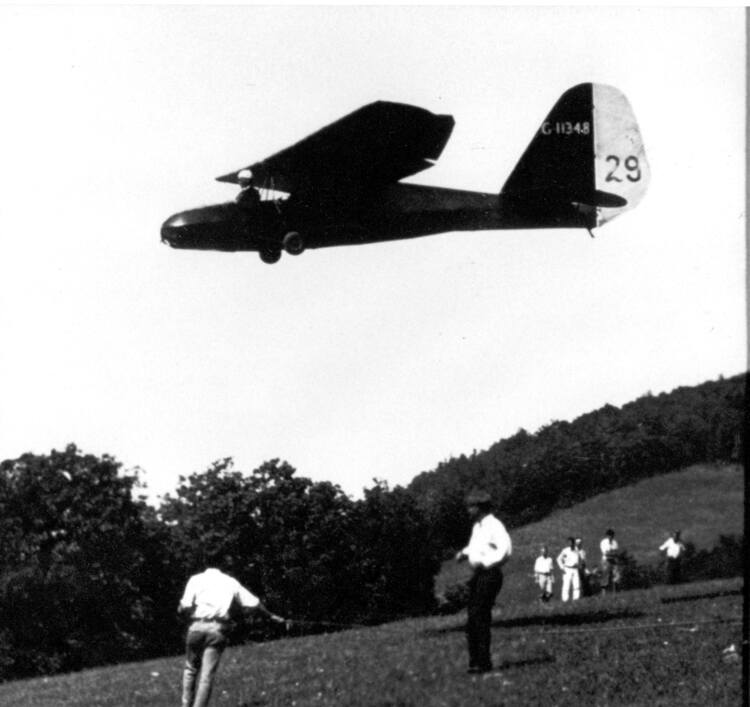
The aircraft's name was derived from its appearance in flight, which was described as eerie, due to its all black finish.
On at least one occasion the Sky Ghost was bungee launched from Harris Hill, New York.
The first multi-place glider flight of over two hours ever flown in the USA was completed by Frank Gross in the Sky Ghost. It was also the first multi-place glider entered in the U.S. Nationals when it competed in 1932.
-
The National Soaring Museum
-
Harris Hill History
-
Bowlus Senior Albatross
-
Alby
-
Evans Trophy
-
Barographs
-
What is Gliding?
-
What is Soaring?
-
Ridge Soaring
-
Thermal Soaring
-
Schweizer 1-26
-
Baker-McMillen Cadet
-
Gross Sky Ghost
-
1937 Winch Truck
-
Chanute - Herring Glider
-
Shock Cord Launch
-
1902 Wright Glider Replica
-
Primary Glider
-
Ralph Barnaby Glider Launch from Dirigible
-
1935 Wolf
-
Olympia Meise
-
Midwest Utility Glider - MU-1
-
Franklin PS-2
-
Minimoa
-
BA-102 Two-Place Baby Albatross
-
Bowlus Baby Albatross
-
CG-4
-
LK-10A
-
BG-12BD
-
Ross-Johnson RJ-5
-
Bowlus Super Albatross
-
1911 Wright Glider Replica
-
Schleicher Ka6E
-
Slingsby Kirby Gull
-
Marske Genesis II
-
Zanonia
-
Orlik II
-
Glasflugel H-301 Libelle
-
HP 18
-
Flying Plank
-
Schweizer TG-3
-
Schweizer / SGP 1-1 Primary Glider
-
Schweizer 2-22A
-
Schweizer 1-35
-
Schweizer 1-7 Utility Glider