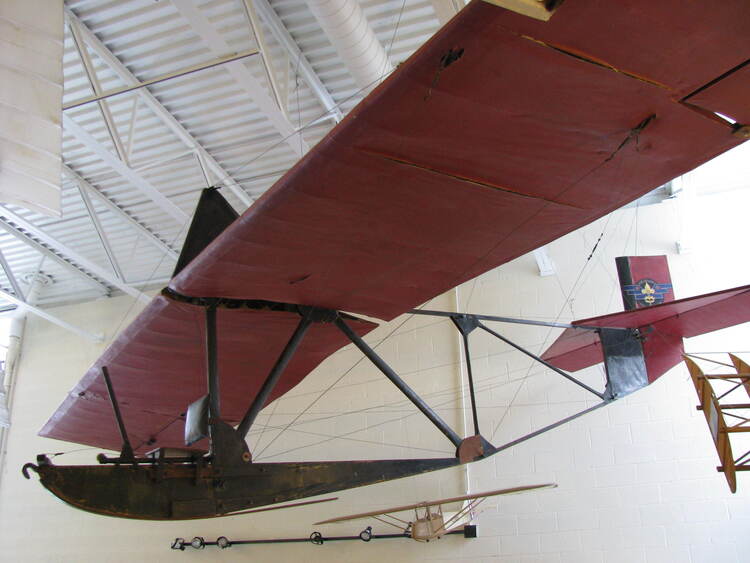
Primary Glider
The museum's primary glider is a German highwing, cable braced, single seat glider that was designed by Alexander Lippisch in 1926 and produced with many variations by a variety of manufacturers.
The primary glider was designed to be a training glider for basic flight training. The usual launch method was by bungee cord from a sloped hill. Because training was conducted solely by solo flight, the aircraft had to be very easy to fly and also easy to repair.
The high wing design uses a kingpost and cable bracing. The primary structure of the glider is of wood, with the wings, tail surfaces and inverted "V" kingpost all finished in doped aircraft fabric covering. The pilot sits on a simple seat in the open air, without a windshield.
The museum's primary glider was donated by the Henry Ford Museum in 2005.
-
The National Soaring Museum
-
Harris Hill History
-
Bowlus Senior Albatross
-
Alby
-
Evans Trophy
-
Barographs
-
What is Gliding?
-
What is Soaring?
-
Ridge Soaring
-
Thermal Soaring
-
Schweizer 1-26
-
Baker-McMillen Cadet
-
Gross Sky Ghost
-
1937 Winch Truck
-
Chanute - Herring Glider
-
Shock Cord Launch
-
1902 Wright Glider Replica
-
Primary Glider
-
Ralph Barnaby Glider Launch from Dirigible
-
1935 Wolf
-
Olympia Meise
-
Midwest Utility Glider - MU-1
-
Franklin PS-2
-
Minimoa
-
BA-102 Two-Place Baby Albatross
-
Bowlus Baby Albatross
-
CG-4
-
LK-10A
-
BG-12BD
-
Ross-Johnson RJ-5
-
Bowlus Super Albatross
-
1911 Wright Glider Replica
-
Schleicher Ka6E
-
Slingsby Kirby Gull
-
Marske Genesis II
-
Zanonia
-
Orlik II
-
Glasflugel H-301 Libelle
-
HP 18
-
Flying Plank
-
Schweizer TG-3
-
Schweizer / SGP 1-1 Primary Glider
-
Schweizer 2-22A
-
Schweizer 1-35
-
Schweizer 1-7 Utility Glider