Bowlus Senior Albatross
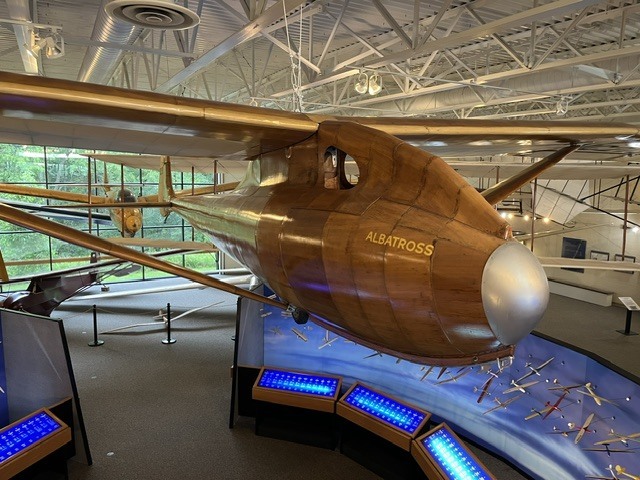
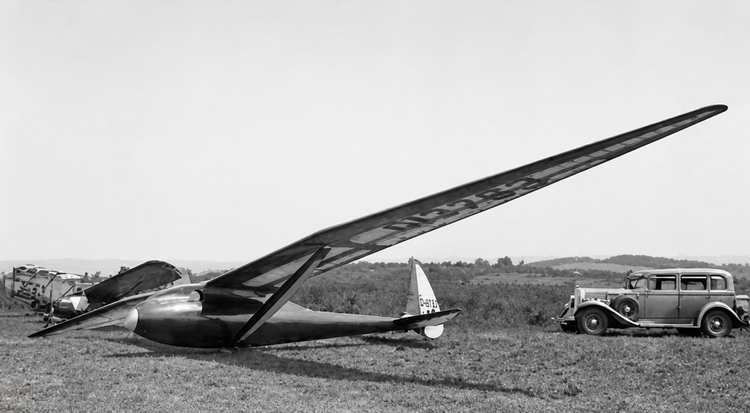
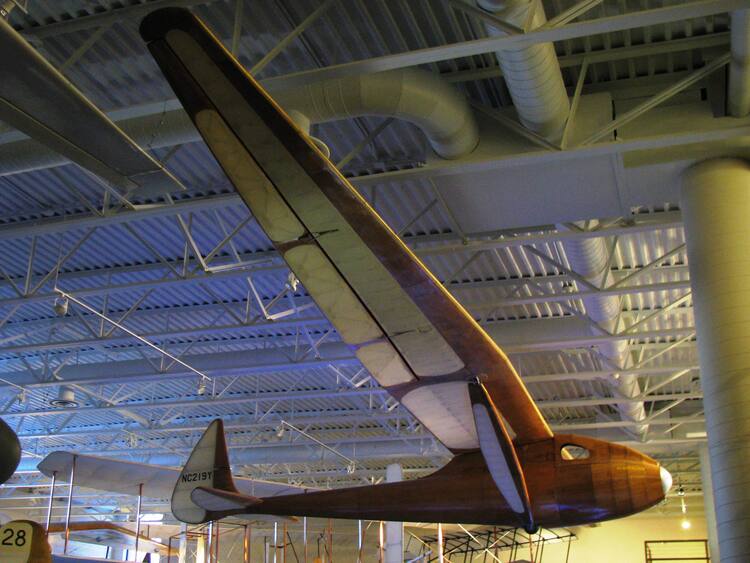
West Coast soaring pioneer, William Hawley Bowlus, designed the high-performance Albatross prototype in 1932 with all wood construction and fabric covered wings. It was the most advanced US sailplane of its time and was also one of the first high-performance sailplanes to use a landing wheel, rather than a skid.
Bowlus and Martin Schempp conducted flight tests from the Palos Verdes Hills near Los Angeles, but the sailplane was lost in October 1932 when Schempp had to ditch at sea after encountering adverse winds.
In 1933, Soaring Society of America president, Warren Eaton, ordered an Albatross, covered in mahogany and christened, "The Falcon". Approximately 6 production Albatross sailplanes were built.
Richard duPont ordered the Albatross displayed here, which was covered with Spruce plywood. He used it to set an unofficial world distance record of 153 miles in June 1934, flying from Elmira to within sight of New York City. He also used it to win the 1934 and 1935 National Soaring Contests. After the 1935 Nationals, duPont sold this Albatross to Chet Decker, who used it to win the 1936 National Soaring Contest. It was used in the 1939 Nationals and then retired to storage, where it would remain for almost 40 years before it was rediscovered and donated to the National Soaring Museum in 1977 by Chet Decker.
-
The National Soaring Museum
-
Harris Hill History
-
Bowlus Senior Albatross
-
Alby
-
Evans Trophy
-
Barographs
-
What is Gliding?
-
What is Soaring?
-
Ridge Soaring
-
Thermal Soaring
-
Schweizer 1-26
-
Baker-McMillen Cadet
-
Gross Sky Ghost
-
1937 Winch Truck
-
Chanute - Herring Glider
-
Shock Cord Launch
-
1902 Wright Glider Replica
-
Primary Glider
-
Ralph Barnaby Glider Launch from Dirigible
-
1935 Wolf
-
Olympia Meise
-
Midwest Utility Glider - MU-1
-
Franklin PS-2
-
Minimoa
-
BA-102 Two-Place Baby Albatross
-
Bowlus Baby Albatross
-
CG-4
-
LK-10A
-
BG-12BD
-
Ross-Johnson RJ-5
-
Bowlus Super Albatross
-
1911 Wright Glider Replica
-
Schleicher Ka6E
-
Slingsby Kirby Gull
-
Marske Genesis II
-
Zanonia
-
Orlik II
-
Glasflugel H-301 Libelle
-
HP 18
-
Flying Plank
-
Schweizer TG-3
-
Schweizer / SGP 1-1 Primary Glider
-
Schweizer 2-22A
-
Schweizer 1-35
-
Schweizer 1-7 Utility Glider