Thermal Soaring
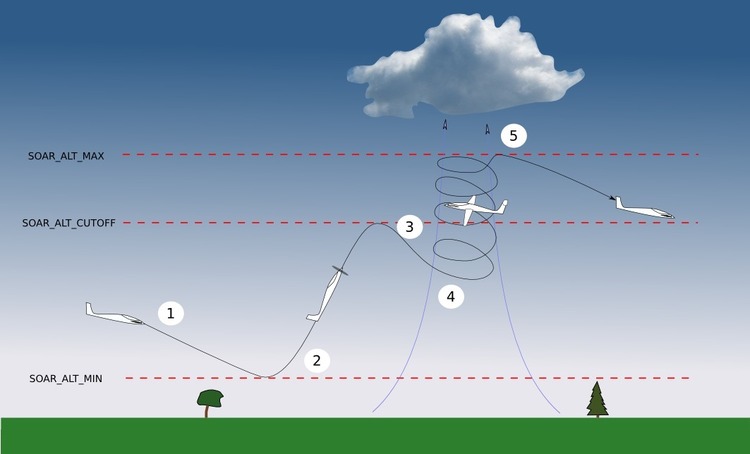
First you have to ask yourself - What's a "thermal"? Simply put, a thermal is a column of rising warm air generated by a heat source on the ground. Plowed fields, parking lots, any dark area that absorbs sunlight and gets hot will serve the purpose of providing thermal lift. If rising warm air is ascending at 5 feet per second and the sailplane is descending through it at 2 feet per second, then the sailplane will be carried upward at 3 feet per second, in many cases for thousands of feet!
Now that we know what a thermal is - how do we find them? You can purposely fly your sailplane over areas that appear to be heat sources, but you really need a device that will quickly tell you whether or not you are in an area of lift. In the late 1920s, German sailplane pilots developed the variometer, which is a highly sensitive vertical speed indicator. As the sailplane enters an area of lift and begins to climb, the outside air pressure decreases and the instrument will immediately react to this upward motion and indicate that you have found a thermal. It will also tell you when you're in a major sink area and are coming down like a rock. By watching the variometer carefully and making adjustments to your position relative to the area of lift, you can center the thermal and climb faster. Another helpful factor is that rising moist air will reach a condensation point and form a cumulus cloud. Fly under such a cloud and you are very likely to find some lift.
This technology made it possible for sailplane pilots to leave ridge soaring behind and, by hopping from one thermal to another, make cross-country flights that could exceed hundreds of miles! This major advancement brought about the era of modern soaring.
-
The National Soaring Museum
-
Harris Hill History
-
Bowlus Senior Albatross
-
Alby
-
Evans Trophy
-
Barographs
-
What is Gliding?
-
What is Soaring?
-
Ridge Soaring
-
Thermal Soaring
-
Schweizer 1-26
-
Baker-McMillen Cadet
-
Gross Sky Ghost
-
1937 Winch Truck
-
Chanute - Herring Glider
-
Shock Cord Launch
-
1902 Wright Glider Replica
-
Primary Glider
-
Ralph Barnaby Glider Launch from Dirigible
-
1935 Wolf
-
Olympia Meise
-
Midwest Utility Glider - MU-1
-
Franklin PS-2
-
Minimoa
-
BA-102 Two-Place Baby Albatross
-
Bowlus Baby Albatross
-
CG-4
-
LK-10A
-
BG-12BD
-
Ross-Johnson RJ-5
-
Bowlus Super Albatross
-
1911 Wright Glider Replica
-
Schleicher Ka6E
-
Slingsby Kirby Gull
-
Marske Genesis II
-
Zanonia
-
Orlik II
-
Glasflugel H-301 Libelle
-
HP 18
-
Flying Plank
-
Schweizer TG-3
-
Schweizer / SGP 1-1 Primary Glider
-
Schweizer 2-22A
-
Schweizer 1-35
-
Schweizer 1-7 Utility Glider