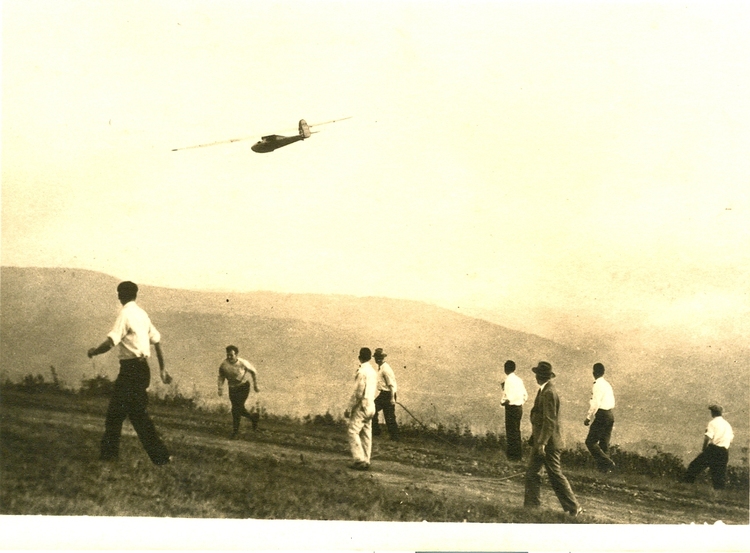

Shock Cord Launch
Shock cord launching was developed in Germany in 1920 and was used in the US for the first time in 1928. A shock cord is simply a 200 foot length of bungee cord attached to a simple hook on the nose of the glider, forming a V with 100 feet on each side of the glider. Gripping the ends of this cord were up to 12 men. Once given the signal from the pilot, they started running in the direction of flight as fast as they could go. Two additional men were holding onto a rope attached to the tail of the glider to keep it from moving. When they were signaled by the pilot, they let go. The result was the glider literally being slingshot into the air. As the glider passed over the running launch crew, the cord slipped off the hook. This was a common method of launching in the early days of the sport and it was very exciting!
-
The National Soaring Museum
-
Harris Hill History
-
Bowlus Senior Albatross
-
Alby
-
Evans Trophy
-
Barographs
-
What is Gliding?
-
What is Soaring?
-
Ridge Soaring
-
Thermal Soaring
-
Schweizer 1-26
-
Baker-McMillen Cadet
-
Gross Sky Ghost
-
1937 Winch Truck
-
Chanute - Herring Glider
-
Shock Cord Launch
-
1902 Wright Glider Replica
-
Primary Glider
-
Ralph Barnaby Glider Launch from Dirigible
-
1935 Wolf
-
Olympia Meise
-
Midwest Utility Glider - MU-1
-
Franklin PS-2
-
Minimoa
-
BA-102 Two-Place Baby Albatross
-
Bowlus Baby Albatross
-
CG-4
-
LK-10A
-
BG-12BD
-
Ross-Johnson RJ-5
-
Bowlus Super Albatross
-
1911 Wright Glider Replica
-
Schleicher Ka6E
-
Slingsby Kirby Gull
-
Marske Genesis II
-
Zanonia
-
Orlik II
-
Glasflugel H-301 Libelle
-
HP 18
-
Flying Plank
-
Schweizer TG-3
-
Schweizer / SGP 1-1 Primary Glider
-
Schweizer 2-22A
-
Schweizer 1-35
-
Schweizer 1-7 Utility Glider