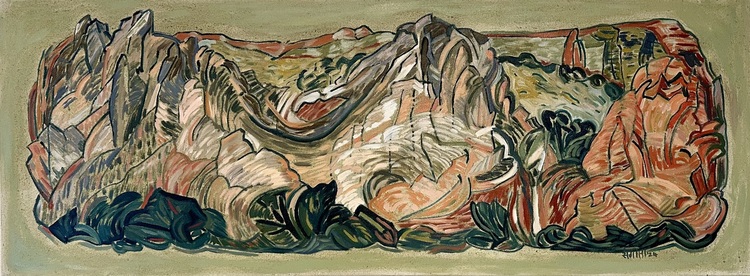
Sangeeta Reddy "Garden of the Gods#2"
My obsession with rock formations and landscape of the Front Range and the Colorado Plateau is a result of the keen loss of landscape I felt in my childhood. The iconic rocks of Hyderabad were dynamited away in the wake of rampant growth. In the drawing of these I try to compensate for that earlier loss.
During Covid, as all our movements were restricted, I found myself working mostly from photographs. Both mine, and what I could find online, sometimes promotional, of places I wished I could travel to and see for myself. They were images of mountains and deserts, of rock formations of the front range and from around from my own neighborhood.
As a daily practice, I made small ink line drawings. After doing a number of them, my larger paintings began to reflect their contours rather than geometric planes. The washes and layered brushwork began to reflect the flow of sedimentary rocks which are shaped by millennia’s worth of compression and erosion.
Another feature grew out of this isolation. The formations I portrayed became objects isolated from their surroundings, rather than as previously, a continuation of them. I noticed that the compositions had become the centralized ones of eastern religious icons that persist today on the street and household shrines and temples.
Between 2011 and 2018, my landscape work followed modernistic western landscape traditions and trajectories, and my own colonial education. These new works seem to part ways from that.
-
Grant Adams "Cowgirl Scene"
-
Florence Alfano McEwin "Fire Summer - Sage"
-
Asma Al-Masyabi "False Front"
-
Reen Axtell "Wildflower"
-
Alicia Bailey "An Autobiography Book Two Variant 2"
-
Libby Barbee "Astral America"
-
Andrew Beckham "Ghost Flowers: Big Rooted Spring Beauty at Taylor Glacier CO"
-
Marc Billard "Mountain Meditation 3"
-
Brenda Biondo "Unnatural (Tumbleweeds)"
-
Garret Bock "The Abduction of Billy the Kid"
-
John Bonath "Ghost"
-
Michael Brohman "Frontier"
-
Robert Burch "Barbed Vases"
-
Al Canner "Dusk Rising"
-
Andrea Caretto "My Favorite Shirt"
-
D. Wayne Cochran
-
Rebecca Cuming "Earth Song"
-
Pete Cunis "Underground Complex"
-
Corey Drieth "Reveal #2"
-
Norman Epp "Mother Tree - Fence Line Conversation"
-
Melody Epperson "Voices From the Land"
-
Corrina Espinosa "Rerun: A Western Temporal Paradox"
-
Douglas Fey "Encroachment"
-
J. Michael Gatlin "Grain Elevator"
-
Christy Georg "Untitled (Sailor's Saddle)"
-
Maureen Hearty "Mining My Own Business"
-
Alexander Heilner "Intrepid Potash Mine"
-
Alexander Heilner "Las Vegas Paiute Golf Resort"
-
Tsehai Johnson "Bloom"
-
Vicki Lee Johnston "Ford Fur"
-
Anna Kaye "Magnify"
-
Eric Laurson
-
Jim Leggitt "Lost Stories: Central City"
-
Frank Lucero "Enchantment"
-
Chris May "Spirit Chasers"
-
Susan Moldenhauer "Insignia"
-
Johanna Mueller "Crossing Paths at Devils Gultch"
-
Sean O'Meallie "A Jar of Candy Poppers"
-
Corey Pickett "Untitled - Revolver and Ray Gun"
-
R. Ragels
-
Sangeeta Reddy "Garden of the Gods#2"
-
Kim Roberts "Sundown"
-
William Rumley "The Gift"
-
William Rumley "Memory of a Goldfish"
-
William Rumley "Moth to Flame"
-
William Rumley "Out with the Old, In with the New"
-
William Rumley "Pronouns"
-
William Rumley "Three Blind Mice"
-
William Rumley " Allure Series Statement"
-
Pedro Saldarriaga "Rodeo Rider No. 10"
-
Heather Schulte "Oh, Give Me a Home"
-
Sharon Strasburg "Distant Rhythms"
-
Brenda Stumpf "Validus"
-
Bala Thiagarajan "Not 99 Percent"
-
Mary Williams "Bronze Aspen Totem"