Melody Epperson "Voices From the Land"
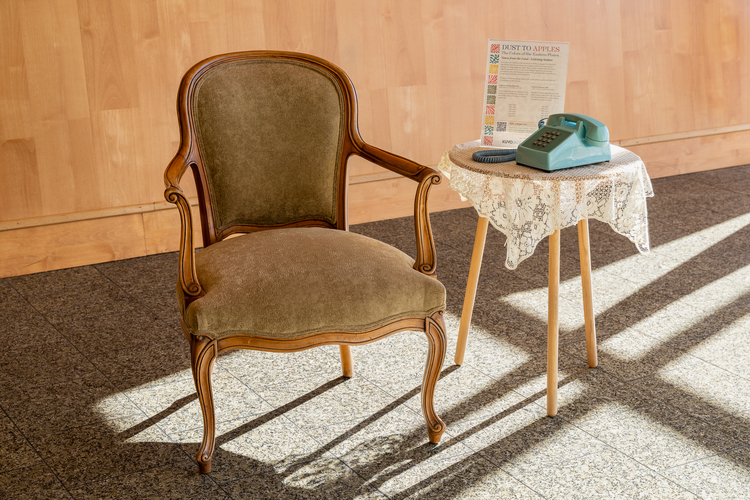
This piece was inspired by a recorded conversation from the 1970s, in which my maternal grandparents spoke about one of the most formative chapters of their lives. As I remember it, the entire family gathered — my mother's siblings, my cousins, all of us sitting in a wide circle — while my grandparents described the moment they made the decision to leave their farm in southeastern Colorado during the Dust Bowl.
My grandfather and his brother's family made enormous sacrifices to escape the droughts and dust storms of the 1930s. They sold the family car, brought in wild horses to be broken and trained, and set out with two covered wagons — traveling from Springfield all the way to Guffey, a small mountain town above Cañon City.
I was lucky enough to inherit those recordings. I call them The Hill Tapes, named after my grandparents, Leslie and Florence Hill. One of the recordings is my mother, Laurie Gibb, reading aloud from my grandmother's diary.
The phone in front of you is a portal into that world. When you dial, the primary voice you'll hear is my grandmother Florence's — unhurried and unguarded, offering small, vivid moments from that time.
She remembers her garden before the dust came. She describes the storms themselves, the covered wagon, the long journey up through the canyon with the horses. Taken together, her stories open a window into something universal: the profound and lasting way that our environment shapes who we are, and what we are forced to leave behind.
To listen to the sound recordings, pick up the receiver and wait for the dial tone. Then punch in the seven-digit phone number listed in the directory.
-
Grant Adams "Cowgirl Scene"
-
Florence Alfano McEwin "Fire Summer - Sage"
-
Asma Al-Masyabi "False Front"
-
Reen Axtell "Wildflower"
-
Alicia Bailey "An Autobiography Book Two Variant 2"
-
Libby Barbee "Astral America"
-
Andrew Beckham "Ghost Flowers: Big Rooted Spring Beauty at Taylor Glacier CO"
-
Marc Billard "Mountain Meditation 3"
-
Brenda Biondo "Unnatural (Tumbleweeds)"
-
Garret Bock "The Abduction of Billy the Kid"
-
John Bonath "Ghost"
-
Michael Brohman "Frontier"
-
Robert Burch "Barbed Vases"
-
Al Canner "Dusk Rising"
-
Andrea Caretto "My Favorite Shirt"
-
D. Wayne Cochran
-
Rebecca Cuming "Earth Song"
-
Pete Cunis "Underground Complex"
-
Corey Drieth "Reveal #2"
-
Norman Epp "Mother Tree - Fence Line Conversation"
-
Melody Epperson "Voices From the Land"
-
Corrina Espinosa "Rerun: A Western Temporal Paradox"
-
Douglas Fey "Encroachment"
-
J. Michael Gatlin "Grain Elevator"
-
Christy Georg "Untitled (Sailor's Saddle)"
-
Maureen Hearty "Mining My Own Business"
-
Alexander Heilner "Intrepid Potash Mine"
-
Alexander Heilner "Las Vegas Paiute Golf Resort"
-
Tsehai Johnson "Bloom"
-
Vicki Lee Johnston "Ford Fur"
-
Anna Kaye "Magnify"
-
Eric Laurson
-
Jim Leggitt "Lost Stories: Central City"
-
Frank Lucero "Enchantment"
-
Chris May "Spirit Chasers"
-
Susan Moldenhauer "Insignia"
-
Johanna Mueller "Crossing Paths at Devils Gultch"
-
Sean O'Meallie "A Jar of Candy Poppers"
-
Corey Pickett "Untitled - Revolver and Ray Gun"
-
R. Ragels
-
Sangeeta Reddy "Garden of the Gods#2"
-
Kim Roberts "Sundown"
-
William Rumley "The Gift"
-
William Rumley "Memory of a Goldfish"
-
William Rumley "Moth to Flame"
-
William Rumley "Out with the Old, In with the New"
-
William Rumley "Pronouns"
-
William Rumley "Three Blind Mice"
-
William Rumley " Allure Series Statement"
-
Pedro Saldarriaga "Rodeo Rider No. 10"
-
Heather Schulte "Oh, Give Me a Home"
-
Sharon Strasburg "Distant Rhythms"
-
Brenda Stumpf "Validus"
-
Bala Thiagarajan "Not 99 Percent"
-
Mary Williams "Bronze Aspen Totem"