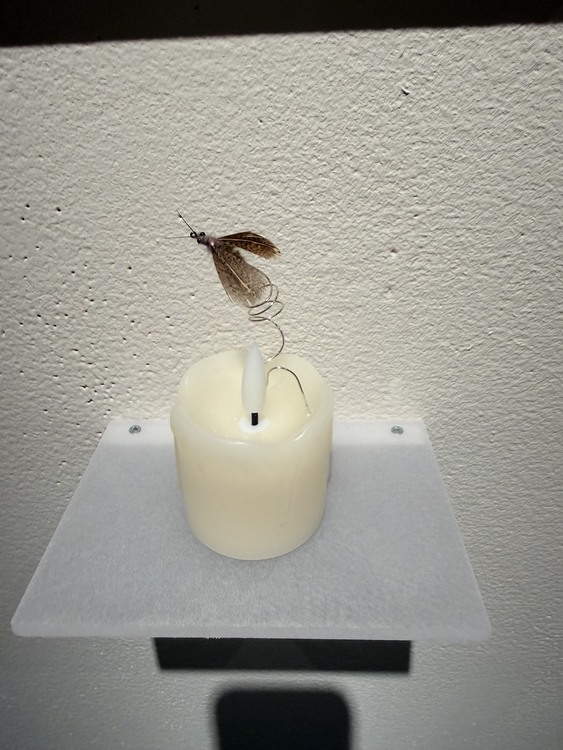
William Rumley "Moth to Flame"
Entomology has always drawn me in—not only for its connection to fly fishing but for how it reveals hidden order in nature. To study insects is to glimpse quiet logic beneath the surface of what we take for granted.
One morning, I found a moth lying motionless on my garage floor. Its wings were pale and powdery, fragile yet beautiful. I felt a trace of guilt. I had left the light on overnight and imagined it had been lured from its path—drawn into an artificial glow that offered no mercy.
That assumption—that moths are drawn to light—felt obvious and even poetic. We inherit it from experience and centuries of metaphor. Shakespeare wrote, “Thus hath the candle singed the moth.” The image endures as shorthand for irresistible but dangerous attraction, the idea that desire can be fatal.
Yet what I believed was not true. A CNN Wonder Theory article (February 7, 2024) described new research showing that moths are not enchanted by light but disoriented by it. Their navigation, tuned to celestial light, is confused by our lamps. What appears to be attraction is really confusion.
This unsettled me. “Reality,” I realized, is often a temporary frame shaped by what we know. Science moves those frames. Each discovery reshapes facts—and the stories we tell about the world and ourselves.
The old metaphor still describes human longing and risk, but no longer literally. The moth was never seduced; it was trapped. That shift changes the moral weight of what happened in my garage. I hadn’t witnessed tragic inevitability but the unintended consequences of human invention disrupting a creature’s ancient navigation.
Such moments remind me that our grasp of reality is provisional. As knowledge grows, so does responsibility. The lights we leave burning at night and the changes we impose on nature are not neutral—they shape other lives in unseen ways until understanding catches up.
Knowledge is alive. Letting go of old beliefs and accepting the strangeness of truth sustains both humility and survival. The story of the moth is no longer about fatal attraction but about how our certainties mislead us—and how learning can reveal the hidden costs of even small habits.
-
Grant Adams "Cowgirl Scene"
-
Florence Alfano McEwin "Fire Summer - Sage"
-
Asma Al-Masyabi "False Front"
-
Reen Axtell "Wildflower"
-
Alicia Bailey "An Autobiography Book Two Variant 2"
-
Libby Barbee "Astral America"
-
Andrew Beckham "Ghost Flowers: Big Rooted Spring Beauty at Taylor Glacier CO"
-
Marc Billard "Mountain Meditation 3"
-
Brenda Biondo "Unnatural (Tumbleweeds)"
-
Garret Bock "The Abduction of Billy the Kid"
-
John Bonath "Ghost"
-
Michael Brohman "Frontier"
-
Robert Burch "Barbed Vases"
-
Al Canner "Dusk Rising"
-
Andrea Caretto "My Favorite Shirt"
-
D. Wayne Cochran
-
Rebecca Cuming "Earth Song"
-
Pete Cunis "Underground Complex"
-
Corey Drieth "Reveal #2"
-
Norman Epp "Mother Tree - Fence Line Conversation"
-
Melody Epperson "Voices From the Land"
-
Corrina Espinosa "Rerun: A Western Temporal Paradox"
-
Douglas Fey "Encroachment"
-
J. Michael Gatlin "Grain Elevator"
-
Christy Georg "Untitled (Sailor's Saddle)"
-
Maureen Hearty "Mining My Own Business"
-
Alexander Heilner "Intrepid Potash Mine"
-
Alexander Heilner "Las Vegas Paiute Golf Resort"
-
Tsehai Johnson "Bloom"
-
Vicki Lee Johnston "Ford Fur"
-
Anna Kaye "Magnify"
-
Eric Laurson
-
Jim Leggitt "Lost Stories: Central City"
-
Frank Lucero "Enchantment"
-
Chris May "Spirit Chasers"
-
Susan Moldenhauer "Insignia"
-
Johanna Mueller "Crossing Paths at Devils Gultch"
-
Sean O'Meallie "A Jar of Candy Poppers"
-
Corey Pickett "Untitled - Revolver and Ray Gun"
-
R. Ragels
-
Sangeeta Reddy "Garden of the Gods#2"
-
Kim Roberts "Sundown"
-
William Rumley "The Gift"
-
William Rumley "Memory of a Goldfish"
-
William Rumley "Moth to Flame"
-
William Rumley "Out with the Old, In with the New"
-
William Rumley "Pronouns"
-
William Rumley "Three Blind Mice"
-
William Rumley " Allure Series Statement"
-
Pedro Saldarriaga "Rodeo Rider No. 10"
-
Heather Schulte "Oh, Give Me a Home"
-
Sharon Strasburg "Distant Rhythms"
-
Brenda Stumpf "Validus"
-
Bala Thiagarajan "Not 99 Percent"
-
Mary Williams "Bronze Aspen Totem"