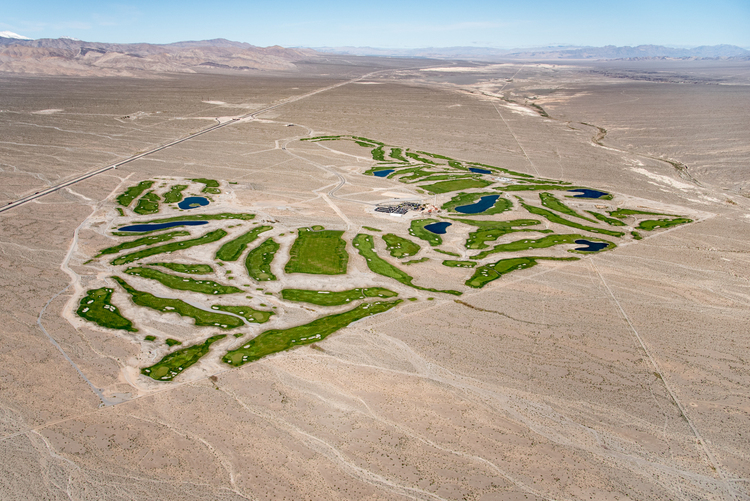
Alexander Heilner "Las Vegas Paiute Golf Resort"
My name is Alex Heilner, and I made this photograph while flying over Las Vegas, Nevada in 2016.
I had hired a small plane one morning to photograph the northern fringes of Las Vegas, where one of the fastest growing cities in America abruptly stops at the edge of the desert. I was fixated on the dramatic contrasts between the dense suburban development, which relies heavily on water from the nearby Colorado River, and the arid emptiness that is often literally across the street. But as we flew northwest from the city, the Paiute Golf Resort revealed itself to be an even more amazing site on the horizon.
Until the 20th century, the American Southwest was incredibly dry, and barely populated, threaded by a handful of precious rivers, where indigenous, and then Spanish, and then Anglo settlers built their small towns. But over the last century, the impulse to move water away from the rivers, to dry expanses of land has proved irresistible. And few landscapes illustrate this hydro-engineering more dramatically than desert golf courses. This one, owned and operated by the Las Vegas Paiute Tribe, pumps its water from aquifers deep below their reservation.
Many people are not aware that aquifers and local river systems are interconnected through the ground, and essentially recharge one another. So, as the water crisis in the Southwest accelerates, all water use is affected, and even ground-water users are beginning to feel social and legal pressure to conserve.
-
Grant Adams "Cowgirl Scene"
-
Florence Alfano McEwin "Fire Summer - Sage"
-
Asma Al-Masyabi "False Front"
-
Reen Axtell "Wildflower"
-
Alicia Bailey "An Autobiography Book Two Variant 2"
-
Libby Barbee "Astral America"
-
Andrew Beckham "Ghost Flowers: Big Rooted Spring Beauty at Taylor Glacier CO"
-
Marc Billard "Mountain Meditation 3"
-
Brenda Biondo "Unnatural (Tumbleweeds)"
-
Garret Bock "The Abduction of Billy the Kid"
-
John Bonath "Ghost"
-
Michael Brohman "Frontier"
-
Robert Burch "Barbed Vases"
-
Al Canner "Dusk Rising"
-
Andrea Caretto "My Favorite Shirt"
-
D. Wayne Cochran
-
Rebecca Cuming "Earth Song"
-
Pete Cunis "Underground Complex"
-
Corey Drieth "Reveal #2"
-
Norman Epp "Mother Tree - Fence Line Conversation"
-
Melody Epperson "Voices From the Land"
-
Corrina Espinosa "Rerun: A Western Temporal Paradox"
-
Douglas Fey "Encroachment"
-
J. Michael Gatlin "Grain Elevator"
-
Christy Georg "Untitled (Sailor's Saddle)"
-
Maureen Hearty "Mining My Own Business"
-
Alexander Heilner "Intrepid Potash Mine"
-
Alexander Heilner "Las Vegas Paiute Golf Resort"
-
Tsehai Johnson "Bloom"
-
Vicki Lee Johnston "Ford Fur"
-
Anna Kaye "Magnify"
-
Eric Laurson
-
Jim Leggitt "Lost Stories: Central City"
-
Frank Lucero "Enchantment"
-
Chris May "Spirit Chasers"
-
Susan Moldenhauer "Insignia"
-
Johanna Mueller "Crossing Paths at Devils Gultch"
-
Sean O'Meallie "A Jar of Candy Poppers"
-
Corey Pickett "Untitled - Revolver and Ray Gun"
-
R. Ragels
-
Sangeeta Reddy "Garden of the Gods#2"
-
Kim Roberts "Sundown"
-
William Rumley "The Gift"
-
William Rumley "Memory of a Goldfish"
-
William Rumley "Moth to Flame"
-
William Rumley "Out with the Old, In with the New"
-
William Rumley "Pronouns"
-
William Rumley "Three Blind Mice"
-
William Rumley " Allure Series Statement"
-
Pedro Saldarriaga "Rodeo Rider No. 10"
-
Heather Schulte "Oh, Give Me a Home"
-
Sharon Strasburg "Distant Rhythms"
-
Brenda Stumpf "Validus"
-
Bala Thiagarajan "Not 99 Percent"
-
Mary Williams "Bronze Aspen Totem"