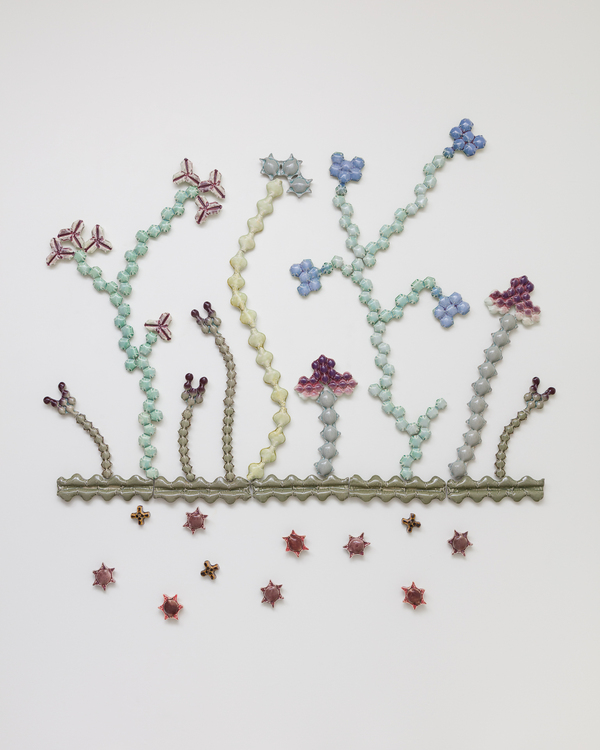
Tsehai Johnson "Bloom"
Generally, I investigate the relationship between material culture, daily ritual, and systems of consumption. I am drawn to the spaces where public and private life intersect and to ordinary practices such as, eating, storing, cleaning, discarding, that structure our lives. Through ceramic objects, installations, and socially engaged projects, I examine how seemingly neutral materials carry the imprints of labor, value, and choice, revealing how beauty, design and material logic coexist with fragility, waste, and renewal.
Over the past five years, my practice has focused on the paradoxes of domestic life and ecological interdependence, using discarded plastics, packing materials, and overlooked plant life as points of entry. Materials destined for the waste stream embody both the excesses of consumption and the persistence of natural systems that thrive despite neglect. Plastic, often framed as lightweight, efficient, and disposable, is in fact persistently present, permeating bodies, environments, and food systems while remaining largely detached from place, maker, or accountability. I further investigate how pattern languages migrate across materials, examining how the ontological conditions of plastic and ceramic actively shape visual systems, cultural meaning, and modes of perception.
Underlying all my projects is a fascination with the tension between permanence and impermanence; the ceramic object’s capacity to endure for centuries alongside the fleeting life that it represents or serves. My creative practice encourages communal participation and introspection, blurring distinctions between art and life, utility and ritual. In these spaces, I hope to reframe the everyday as an arena of curiosity and transformation; where the delicate, the discarded, and the decorative together reveal the deeper systems that bind us to one another and to the world we inhabit. Through this lens my work becomes a site for reflection, exchange, and shared responsibility, where alternative ways of knowing and living together in a damaged world can be imagined and practiced.
Bloom transforms bubble wrap, a material that as a ceramicist I frequently use and a material meant to be fleeting into enduring porcelain forms, questioning what society deems disposable. By casting these everyday remnants, I reveal their paradoxical permanence: objects designed for a moment may, in fact, outlast us. Through processes of collecting casting, I reimagine plastic’s synthetic fragility as something both beautiful and unsettlingly durable. Bloom is a meditation on consumption where the discarded becomes a permanent decorative object. In merging porcelain’s historical associations with refinement and value with bubble wrap’s ubiquity and waste, I invite reflection on how human habits shape both material and ecological legacies.
I want to talk also a little bit about the process of making Bloom. I go through an elaborate mold making and casting process treating the fragile yet very strong bubble wrap as a material worthy of casting in something like porcelain. That whole process is very labor intensive. So, my studio time becomes a meditation on the impossibility of escaping materials like bubble wrap. Despite my personal reluctance to use it, bubble wrap is actually integral to my daily existence as an artist. For me to show my work in another city. I must ship it, and bubble wrap is typically the best way to secure it during shipping. Thus, through the process of making these pieces I am exploring the bind I am in in my creative practice where I must use these materials but I also force myself to think about the impact on our landscape, our health and the environment when I’m actually making the pieces.
-
Grant Adams "Cowgirl Scene"
-
Florence Alfano McEwin "Fire Summer - Sage"
-
Asma Al-Masyabi "False Front"
-
Reen Axtell "Wildflower"
-
Alicia Bailey "An Autobiography Book Two Variant 2"
-
Libby Barbee "Astral America"
-
Andrew Beckham "Ghost Flowers: Big Rooted Spring Beauty at Taylor Glacier CO"
-
Marc Billard "Mountain Meditation 3"
-
Brenda Biondo "Unnatural (Tumbleweeds)"
-
Garret Bock "The Abduction of Billy the Kid"
-
John Bonath "Ghost"
-
Michael Brohman "Frontier"
-
Robert Burch "Barbed Vases"
-
Al Canner "Dusk Rising"
-
Andrea Caretto "My Favorite Shirt"
-
D. Wayne Cochran
-
Rebecca Cuming "Earth Song"
-
Pete Cunis "Underground Complex"
-
Corey Drieth "Reveal #2"
-
Norman Epp "Mother Tree - Fence Line Conversation"
-
Melody Epperson "Voices From the Land"
-
Corrina Espinosa "Rerun: A Western Temporal Paradox"
-
Douglas Fey "Encroachment"
-
J. Michael Gatlin "Grain Elevator"
-
Christy Georg "Untitled (Sailor's Saddle)"
-
Maureen Hearty "Mining My Own Business"
-
Alexander Heilner "Intrepid Potash Mine"
-
Alexander Heilner "Las Vegas Paiute Golf Resort"
-
Tsehai Johnson "Bloom"
-
Vicki Lee Johnston "Ford Fur"
-
Anna Kaye "Magnify"
-
Eric Laurson
-
Jim Leggitt "Lost Stories: Central City"
-
Frank Lucero "Enchantment"
-
Chris May "Spirit Chasers"
-
Susan Moldenhauer "Insignia"
-
Johanna Mueller "Crossing Paths at Devils Gultch"
-
Sean O'Meallie "A Jar of Candy Poppers"
-
Corey Pickett "Untitled - Revolver and Ray Gun"
-
R. Ragels
-
Sangeeta Reddy "Garden of the Gods#2"
-
Kim Roberts "Sundown"
-
William Rumley "The Gift"
-
William Rumley "Memory of a Goldfish"
-
William Rumley "Moth to Flame"
-
William Rumley "Out with the Old, In with the New"
-
William Rumley "Pronouns"
-
William Rumley "Three Blind Mice"
-
William Rumley " Allure Series Statement"
-
Pedro Saldarriaga "Rodeo Rider No. 10"
-
Heather Schulte "Oh, Give Me a Home"
-
Sharon Strasburg "Distant Rhythms"
-
Brenda Stumpf "Validus"
-
Bala Thiagarajan "Not 99 Percent"
-
Mary Williams "Bronze Aspen Totem"