Timeline
Rocky Flats
Production, Protest, & Legacy
(a brief timeline)
Plant Origins, Operations & Early Accidents
1945 – The advent of atomic weapons and the bombings of Hiroshima and Nagasaki usher in the nuclear age; World War II ends.
Late 1940s – The U.S. nuclear weapons complex rapidly expands after the Soviet Union develops its own atomic weapons; the Cold War begins.
1951 – As the Cold War intensifies, the Atomic Energy Commission selects and acquires the Rocky Flats site northwest of Denver.
1952 – Construction begins; the hydrogen bomb era begins as thermonuclear weapons enter U. S. strategy.
1953 – Rocky Flats begins producing plutonium triggers (“pits”) for thermonuclear clear weapons, many times more powerful than earlier atomic bombs.
September 11, 1957 – A major fire in Building 771 contaminates the facility and releases plutonium into the environment; the public is not notified.
May 11, 1969 – A catastrophic fire in Buildings 776/777, later remembered as “The Day We Almost Lost Denver.”
1970 – Off-site contamination is identified by Dr. Carl Johnson and Dr. Ed Martell; a worker strike by the United Steelworkers highlights tensions over labor, safety, and plant conditions.
Rise of Activism
1974 – The Rocky Flats Action Group forms in opposition to the “local hazard and global threat” posed by the nuclear weapons plant.
1978 – Protest draws 6,000; the Rocky Flats Truth Force forms and begins nonviolent direct action; Thousands arrested for civil disobedience.
1979 – Anti-nuclear rally draws 15,000 and national attention after Three Mile Island incident; hundreds more arrested.
1980 – The Nuclear Freeze campaign is announced at a mass demonstration, linking local resistance to a global disarmament movement.
June 9, 1981 – Denver’s biggest protest ever” keeps Rocky Flats at the center of public debate.
October 15, 1983 – Encirclement of Rocky Flats: protesters form a human chain around the plant perimeter; the Rocky Mountain Peace and Justice Center (RMPJC) forms in Boulder, continuing advocacy through Nuclear Guardianship.
1986 – Environmental Information Network forms to address Rocky Flats’ radiotoxic/hazardous waste issues.
August 10, 1987 – A “Shutdown” civil disobedience action results in hundreds of arrests.
Shutdown & Closure
June 6, 1989 – The FBI and EPA raid Rocky Flats in an unprecedented investigation into environmental crimes; weapons production is halted.
1991 – President George H.W. Bush announces the end of the Cold War.
1992 – A multi-year Special Federal Grand Jury investigation concludes; plant operations plead guilty to 10 environmental crimes; weapons production officially ends.
1994 – Building 889, the first radioactively contaminated structure at Rocky Flats, is demolished.
1998 – The site is added to the National Register of Historic Places; exaction of Trench 1 takes place.
1999 – Plutonium pits are shipped off-site; Building 779 is demolished.
2000-2001 – Secretary of Energy Bill Richardson acknowledged workers were misled about health risks as federal compensation expands; legislation advances conversation of the site into the Rocky Flats National Wildlife Refuge; the Rocky Flats Cold War Museum is established.
2003-2005 – Demolition becomes the primary mission; key figures in the Rocky Flats investigation oppose opening the site to the public; the Department of Energy declares cleanup complete in 2005.
2006-2007 – Land is transferred to the U.S. Fish and Wildlife Service.
Post-Closure Legacy
2008 – National Day of Remembrance is recognized for nuclear weapons workers; the Candelas development plan is approved.
2013 – Candelas Glows emerges in response to development near the site.
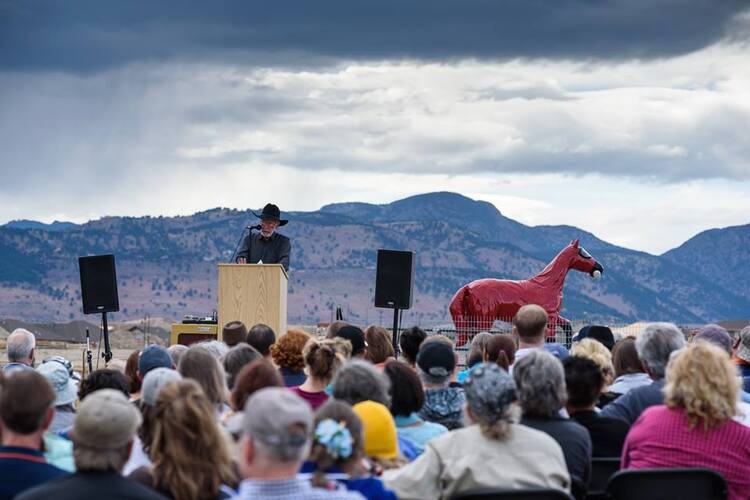
2015 – Cook v. Rockwell reaches a $375 million settlement for plutonium contamination of nearby communities; Rocky Flats Downwinders forms and launches a community health survey; the Cold War Horse memorial is installed.
2016 – Rocky Flats Right to Know expands public education and transparency efforts.
2018 – The refuge opens to the public, intensifying debate over long-term safety.
2019 – Plans for the Jefferson Parkway, a proposed highway along the eastern edge of Rocky Flats, are halted after a plutonium hotspot is identified.
2025 – Boulder County installs warning signage near the refuge boundary.
2026 – Westminster installs expanded warning signage; efforts to advance the Jefferson Parkway resume amid ongoing controversy; plutonium “pit” production continues at Los Alamos National Lab as part of U.S. nuclear weapons modernization.
-
Half-Life of Memory
-
What is Rocky Flats?
-
Voices of Rocky Flats
-
Alchemy: Photographs Taken near the Former Rocky Flats Nuclear Weapons Plant
-
Untitled - Homage to Robert Adams' Our Lives and Our Children: Photographs Taken near the Rocky Flats Nuclear Weapons Plant
-
Broncos/Horses and Rocky Flats
-
Who Controls the Present Controls the Past
-
Trigger
-
Containment Loop
-
Body Burden
-
#771
-
Impression
-
View From the Road
-
Critical Mass
-
Disposition
-
Powder Keg
-
Fallout
-
Rocky Flats Film Trailers
-
Cold War Horse
-
Timeline