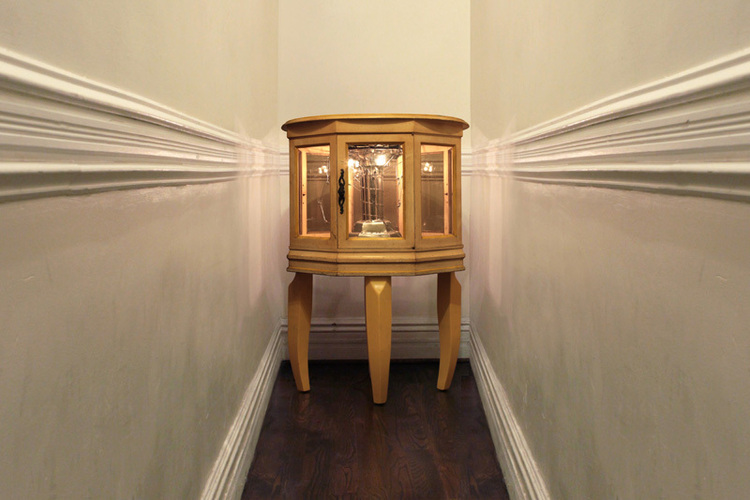
Containment Loop
Containment Loop explores the tensions between plutonium production and the systems designed to contain its dangers. Despite decades of advanced engineering, elaborate safety protocols, and constant monitoring, radioactive contamination repeatedly escaped control during production at Rocky Flats through fires, leaks, and airborne releases. These failures undermined the promise that radioactive materials could be safely contained.
As a kinetic work, Containment Loop itself depends on continuous monitoring and maintenance to remain operational. Over time, the mechanisms will inevitably wear down and fail, mirroring the near-impossible demands placed on systems tasked with containing radioactive materials. Here, failure is not presented as an accident, but as a condition built into the system.
The sculpture is constructed from materials associated with Rocky Flats, including glass, steel, and rubber, and is housed within a contained enclosure. At its center, a carousel-like mechanism loops continuously, referencing the Chainveyor system used to move plutonium through the plant. As it spins, abstracted horse legs run endlessly in a circle, evoking sustained labor and production, and recalling the horse as a recurring metaphor in this body of work.
In Containment Loop, motion never resolves and the cycle never breaks, until it inevitably does. The sculpture serves as a metaphor for Rocky Flats: an industrial system designed simultaneously to create and contain danger, caught in a loop it could never fully control.
-
Half-Life of Memory
-
What is Rocky Flats?
-
Voices of Rocky Flats
-
Alchemy: Photographs Taken near the Former Rocky Flats Nuclear Weapons Plant
-
Untitled - Homage to Robert Adams' Our Lives and Our Children: Photographs Taken near the Rocky Flats Nuclear Weapons Plant
-
Broncos/Horses and Rocky Flats
-
Who Controls the Present Controls the Past
-
Trigger
-
Containment Loop
-
Body Burden
-
#771
-
Impression
-
View From the Road
-
Critical Mass
-
Disposition
-
Powder Keg
-
Fallout
-
Rocky Flats Film Trailers
-
Cold War Horse
-
Timeline