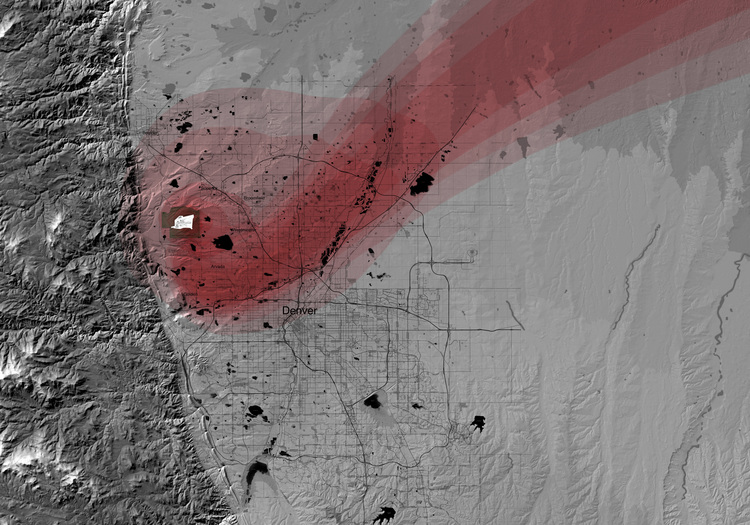
What is Rocky Flats?
Rocky Flats is a former U.S. nuclear weapons manufacturing facility located northwest of Arvada, between Denver and Boulder. From 1952 to 1989, the plant’s primary mission was to produce plutonium bomb cores—often called triggers or pits—for nuclear weapons during the Cold War.
Each of these bomb “triggers” contained the explosive power of an atomic bomb and could unleash up to a thousand times that power when incorporated into thermonuclear weapons. Rocky Flats produced an estimated 70,000 of them, making the site a central engine of the nation’s nuclear weapons complex.
Initiated by the Atomic Energy Commission and later managed by the U.S. Department of Energy, the plant was operated by government contractors and grew into a sprawling complex of 800 structures spanning 10 square miles, including a designated “buffer zone.” Over its operation, up to 50,000 workers were employed at Rocky Flats. Many of them saw their labor as essential to protecting the country and are often described as Cold War veterans. Working on the front lines of nuclear weapons production, they operated within a highly secretive atmosphere and were not always fully informed of the risks to their health.
Behind a veil of national security secrecy, fires, leaks, and improper waste disposal released radioactive contamination into the environment and surrounding communities. Following a major plutonium fire in 1969, evidence of environmental contamination became public, sparking widespread concern and a decade of sustained protest that helped fuel one of the most significant anti-nuclear movements in U.S. history.
In 1989, the FBI and EPA conducted an unprecedented raid on the facility to investigate environmental crimes. After a three-year special federal grand jury investigation, Rocky Flats’ contractor, Rockwell International, pleaded guilty to ten environmental crimes. Facing growing public pressure and unable to achieve environmental compliance, the government ultimately closed the plant. A controversial, decade-long remediation effort followed, leaving widespread contamination in the soils and the most radioactive buildings buried in place.
Today, much of the former buffer zone surrounding Rocky Flats has been designated a national wildlife refuge and opened to the public by the U.S. Fish and Wildlife Service. The central portion of the plant, where radioactive infrastructure remains buried, is off-limits and overseen by the U.S. Department of Energy. While state and federal agencies maintain that the refuge is safe for visitors and nearby communities, former workers, residents, and independent experts continue to raise concerns about lingering contamination and long-term impacts on human health and the environment.
To date, more than 10,000 former Rocky Flats workers have applied for federal compensation for illnesses linked to their employment. A 2016 preliminary health survey, conducted by Metropolitan State University in collaboration with Rocky Flats Downwinders, mapped hundreds of rare cancers in the surrounding areas. The full impact of Rocky Flats remains contested and is not yet fully understood. A community-driven health survey is now underway to gather more information. You can learn more and participate in the survey at: https://rockyflatsdownwinders.com/health-survey/
-
Half-Life of Memory
-
What is Rocky Flats?
-
Voices of Rocky Flats
-
Alchemy: Photographs Taken near the Former Rocky Flats Nuclear Weapons Plant
-
Untitled - Homage to Robert Adams' Our Lives and Our Children: Photographs Taken near the Rocky Flats Nuclear Weapons Plant
-
Broncos/Horses and Rocky Flats
-
Who Controls the Present Controls the Past
-
Trigger
-
Containment Loop
-
Body Burden
-
#771
-
Impression
-
View From the Road
-
Critical Mass
-
Disposition
-
Powder Keg
-
Fallout
-
Rocky Flats Film Trailers
-
Cold War Horse
-
Timeline