Stop 10: Home of Heroes
When Jerry Siegel and Joe Shuster, students at Glenville High School, created Superman, they defined the modern superhero, and in doing so, launched a storytelling tradition that continues to evolve today. Cleveland has remained a place where stories take shape, where creators draw from their surroundings, their communities, and their questions about the world to imagine new kinds of characters. These local stories remind us that all characters, big and small, are shaped by the communities and voices that bring them to life. Terri Libenson captures the emotional weather of childhood and adolescence with wit, empathy, and sharp social nuance. Primarily working digitally, Libenson uses loose, animated lines that mirror her characters’ emotions, with each subtle gesture conveying volumes. The result is an ongoing body of work that affirms individuality while honoring the diverse experiences that inform it. One of the biggest names in comics today, Brian Michael Bendis was born and raised in University Heights, Ohio. Known for his gritty noir themes, dialogue-driven storytelling, and slower, deliberate pacing, Bendis brought a character-focused approach to his mainstream superhero comics. Cartoonist Peter Kuper is perhaps best known for writing and illustrating MAD Magazine’s “Spy vs. Spy,” taking over Antonio Prohías’ creation in 1997 and producing it ever since. Kuper’s bold, high-contrast style uses stencils, spray paint, and woodcut-like techniques to depict geometric figures in gritty urban environments, blending expressionism and surrealism. Whether autobiographical or political, his “high art” comics explore social and psychological themes through
a combination of commentary, satire, and careful observation with chaotic expressiveness.
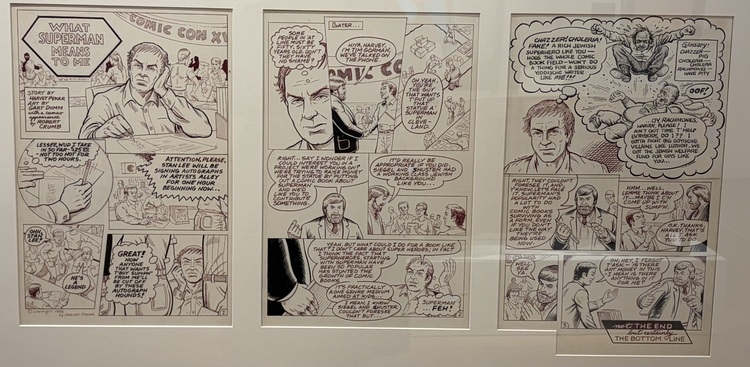
Harvey Pekar was an iconic Cleveland underground comic book writer and jazz critic, best known for his groundbreaking autobiographical series American Splendor.
American Splendor debuted in 1976, when Harvey Pekar self-published a comic unlike almost anything else being produced at the time. While most comics focused on superheroes, fantasy, or adventure, Pekar turned his attention to everyday life. Working as a file clerk at Cleveland's Veterans Administration hospital, he believed that ordinary people and ordinary experiences could provide rich material for storytelling.
The first issue introduced readers to the world that would define the series: record stores, city streets, workplace frustrations, conversations with friends, and the routines of daily life. Pekar wrote about subjects that many people might overlook, but he approached them with humor, honesty, and a sharp eye for human behavior. His stories suggested that there was drama and meaning in the seemingly mundane details of everyday existence.
Because Pekar was not an artist himself, he collaborated with several cartoonists to illustrate his stories, most notably his friend Robert Crumb, an indie comix luminary. Together, they helped create a new kind of comic centered on autobiography and realism.
American Splendor invites comparison with Cleveland’s most famous comics creation. While Superman was introduced by the vivid account “It’s a bird, it’s a plane, it’s Superman!,” the ironically titled American Splendor is prefaced by the less spectacular tag line: “From off the streets of Cleveland comes.” Pekar’s unique, solitary voice conveyed the struggles of Cleveland working-class life, while Superman, created by Jerry Siegel and Joe Shuster, was an imaginary science-fiction figure who could overcome every obstacle. Yet both protagonists—Superman and Pekar himself—tackle injustice and other societal ills: Superman with his physical strength and Pekar with his mighty observations. In that sense, Pekar transformed the ordinary citizen into a kind of everyday hero.
What made American Splendor groundbreaking was its insistence that comics could tell meaningful stories without capes or superpowers. By elevating everyday experiences into art, Pekar expanded the possibilities of the comics medium and helped pave the way for the rise of autobiographical and literary graphic narratives.
-
Stop 1: Famous Funnies
-
Stop 2: Ganefs
-
Stop 3: Contract with God
-
Stop 4: Maus
-
Stop 5: Miki Maoz
-
Stop 6: Fantastic Four
-
Stop 7: Captain America
-
Stop 8: Code for Buddies
-
Stop 9: Superman
-
Stop 10: Home of Heroes
-
Stop 11: Laboratory