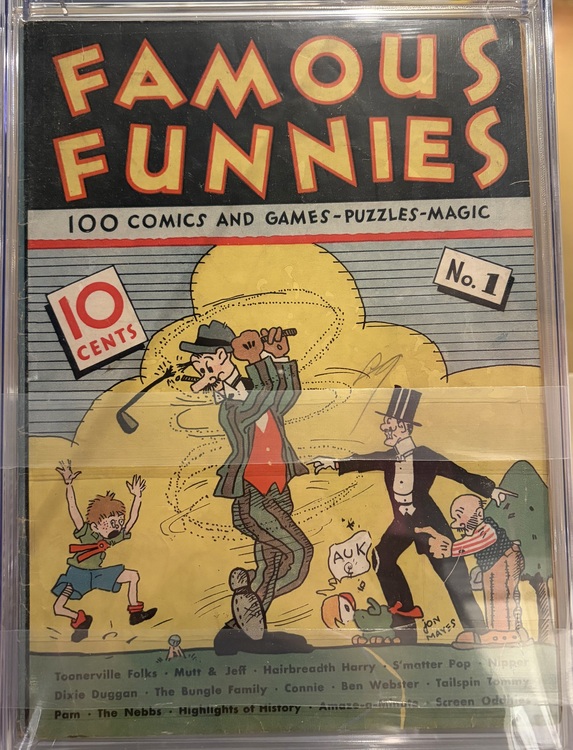
Stop 1: Famous Funnies
The comic book industry began to take shape in the early 20th century, with Jewish immigrants and their children playing a central role in its development. Many turned to this new medium after being excluded from other professions. Drawing on earlier formats, like newspaper strips and pulp magazines, these creators helped establish comic books as a popular and affordable form of entertainment during the Great Depression.
In 1938, Cleveland’s own Jerry Siegel and Joe Shuster introduced Superman, launching a genre that would come to define the medium. As the industry grew, comics evolved from early humor and adventure stories to superheroes, wartime narratives, as well as expanding genres like romance, horror, and crime.
Famous Funnies #1, July 1938. THe comic book medium is a Jewish invention. Until 1934, comics appeared in the form of newspaper strips, and most were comical, hence the name comics. During the throes of the Great Depression, an unemployed schoolteacher from the Bronx, M.C. Gaines, born Maxwell Ginzberg, thought of the idea of licensing old newspaper strips from the syndicates and republishing them in a quarterfold, side-stapeled magazine format: the comic book. Cutting and pasting a variety of newspaper strips, the very first comic book was a Proctor & Gamble giveaway. Gaines then thought of the idea to add a ten-cent sticker to the comics and sell it on newsstands. His thinking was that kids would be willing to part with their allowance instead of waiting for their mom and dad to be finished with the newspaper. And so, in July 1934, Famous Funnies #1, the world's very first comic book, debuted.
-
Stop 1: Famous Funnies
-
Stop 2: Ganefs
-
Stop 3: Contract with God
-
Stop 4: Maus
-
Stop 5: Miki Maoz
-
Stop 6: Fantastic Four
-
Stop 7: Captain America
-
Stop 8: Code for Buddies
-
Stop 9: Superman
-
Stop 10: Home of Heroes
-
Stop 11: Laboratory