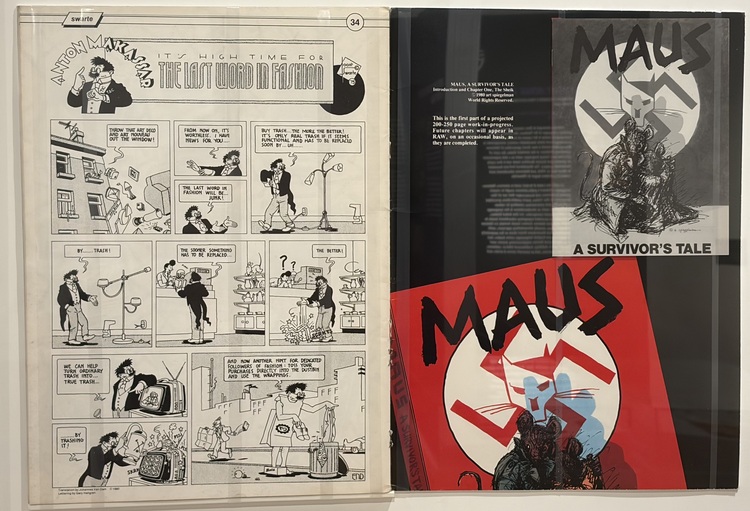
Stop 4: Maus
Maus, by Art Spiegelman, is one of the most influential graphic novels ever created. Published in 1986 and then 1991 as two volumes, it tells the story of Spiegelman’s father, Vladek, a Polish Jew who survived the Holocaust. The book also exploring the complicated relationship between father and son in the decades after World War II.
The book moves between two timelines. One follows Vladek’s experiences before and during the Holocaust, including life in Nazi-occupied Poland, the destruction of Jewish communities, and his imprisonment in Auschwitz. The other takes place in the present, showing Art interviewing his father and struggling to understand both his family’s history and the lasting effects of trauma. This dual narrative makes Maus not only a Holocaust memoir but also a meditation on memory and the challenges of representing historical catastrophe.
One of the work’s most recognizable features is Spiegelman’s use of anthropomorphic animals: Jews are depicted as mice, Germans as cats, Poles as pigs, and Americans as dogs. While visually simple, this device allows Spiegelman to explore questions of identity and prejudice while drawing attention to the ways people are categorized and dehumanized.
Maus brought the graphic novel into mainstream literary and academic discussions. In 1992, it became the first comic to receive a special Pulitzer Prize.
-
Stop 1: Famous Funnies
-
Stop 2: Ganefs
-
Stop 3: Contract with God
-
Stop 4: Maus
-
Stop 5: Miki Maoz
-
Stop 6: Fantastic Four
-
Stop 7: Captain America
-
Stop 8: Code for Buddies
-
Stop 9: Superman
-
Stop 10: Home of Heroes
-
Stop 11: Laboratory