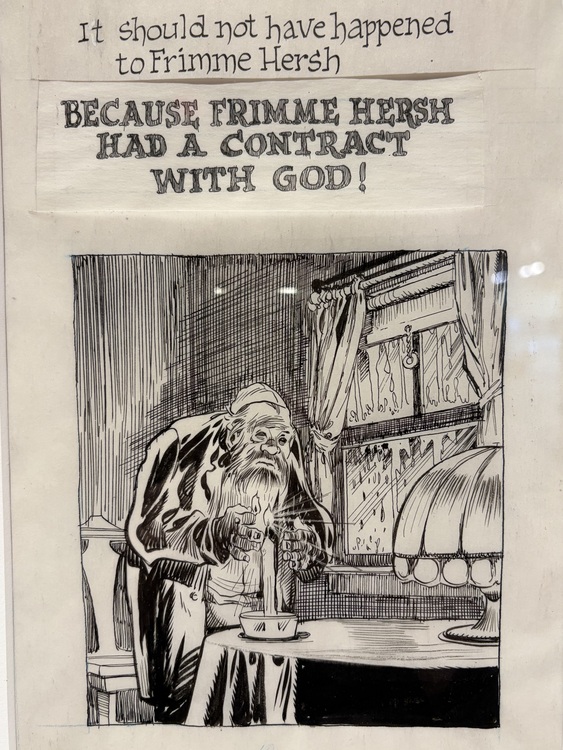
Stop 3: Contract with God
Comics became a vehicle for Jewish cultural expression throughout the 20th century, beginning with Yiddish cartoons in immigrant newspapers. These works offered Jewish humor, imagery, and pushed back against antisemitic portrayals common in American and European media. Early Yiddish cartoons blended Jewish themes and iconography with contemporary social and political issues, creating a distinct visual language rooted in everyday immigrant life. Creators like Will Eisner expanded the medium even further into a vehicle for serious storytelling and personal narratives.
A Contract with God, published in 1978 by Will Eisner, is often credited with helping establish the graphic novel as a serious literary form. Rather than telling a single continuous story, the book consists of four interconnected stories set in a tenement building in the Bronx during the 1930s. Together, the stories explore the struggles, disappointments, hopes, and moral complexities of immigrant and working-class Jewish life.
The title story centers on Frimme Hersh, a devout Jewish man who believes he has a special covenant—or “contract”—with God. After the death of his adopted daughter, however, his faith is shattered, and he begins to question whether God has broken that agreement. Through Hersh’s crisis, Eisner examines themes of faith, loss, justice, and the search for meaning in the face of suffering.
What makes A Contract with God especially significant is not only its subject matter but also its artistic approach. Eisner used expressive page layouts, cinematic storytelling, and emotionally nuanced characters to create a work that felt closer to literature than to traditional comic books. The stories are deeply human, focusing on ordinary people rather than superheroes, and they capture both the hardships and resilience of urban immigrant communities.
A Contract with God remains a landmark in comics history because it demonstrated that the medium could address mature themes and complex emotions with the same depth as novels, film, or fine art. It is widely considered the first graphic novel.
-
Stop 1: Famous Funnies
-
Stop 2: Ganefs
-
Stop 3: Contract with God
-
Stop 4: Maus
-
Stop 5: Miki Maoz
-
Stop 6: Fantastic Four
-
Stop 7: Captain America
-
Stop 8: Code for Buddies
-
Stop 9: Superman
-
Stop 10: Home of Heroes
-
Stop 11: Laboratory