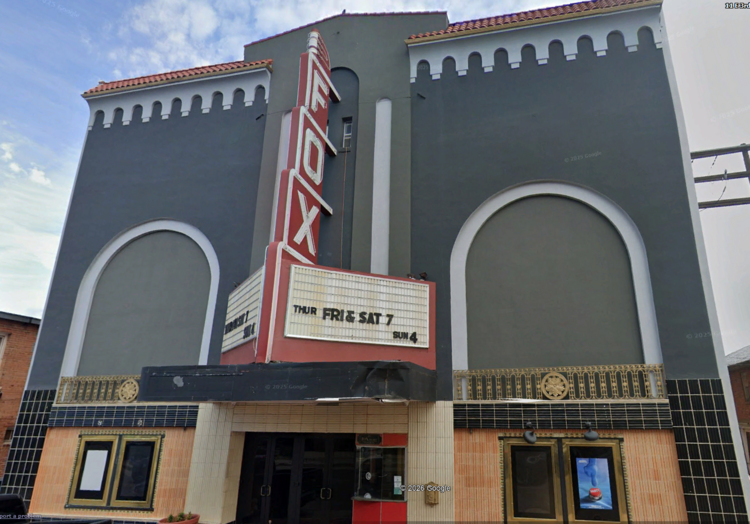
Rourke/Fox Theater 11 E. 3rd St.
In the late 1800s and early 1900s, opera houses played a vital role in the life of a coummunity as the site of public meetings, political conventions, club meetings, balls, dances, lectures, theater performances, concerts, and performances by traveling acts.
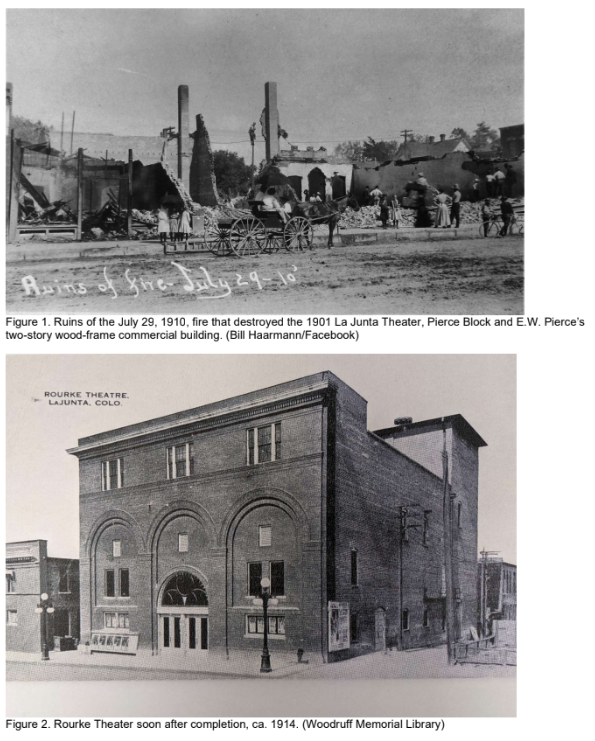
The 1901 La Junta Theatre, a brick two-story building was contructed by opera house promoter and builder Frank P. McClure, and replaced a wood-frame, one-story opera house completed in 1892. Based in St. Louis and Chicago, McClure traveled to cities and towns offering to construct an opera house if the town's citizens were willing to invest in the project, which La Junta's residents did. However, less than a decade after being completed, in the early hours of July 29, 1910, lightning struck the La Junta Theatre. The ensuing fire destroyed the theater building and its immediate neighbors to the north and south.
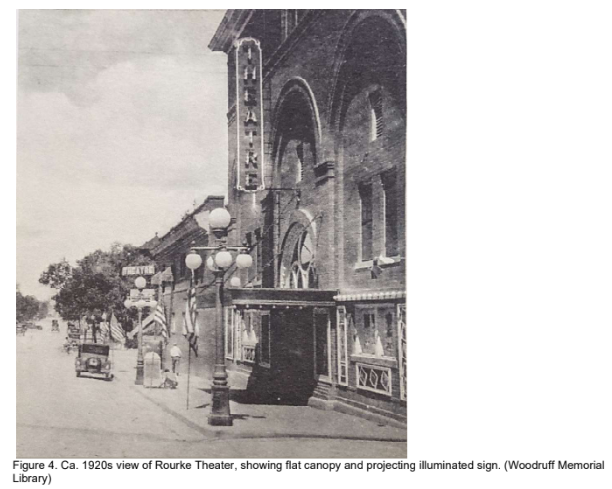
Construction of the new theater began in early September, and construction continued through the end of the year. Near the end of January 1914, the theater building was leased to J.W. Todd, manager of the Rocky Ford opera house for 200 dollars per month. Tickets for shows at the new Rourke Theater, named for Eugene Rourke (one of the directors of the La Junta Theater Company), could be purchased at the pharmacy in the adjacent commercial block, with a sign advertising "THEATER" installed at the corner of that building; according to some residents, a tunnel connects the two buildings' basements. A renowned scenic artist from Denver, J.B. Fulton, painted an "allegorical design" over the proscenium and on the asbestos drop curtain. The opening night of the theater was held on March 9, 1914, with the play "Within the Law." The evening was later reported as a "vision of beauty, the greatest social event that happened in the Arkansas Valley," with ticket sales surpassing the expected $1,000 by almost 50 percent.
In 1925, the live theater space was conveted to show moving pictures on a screen, and a Wurlitzer theater organ, which provided music as well as sound effects such as a horse hoof trot, auto horn, ocean surf, and streetcar bell, was installed.
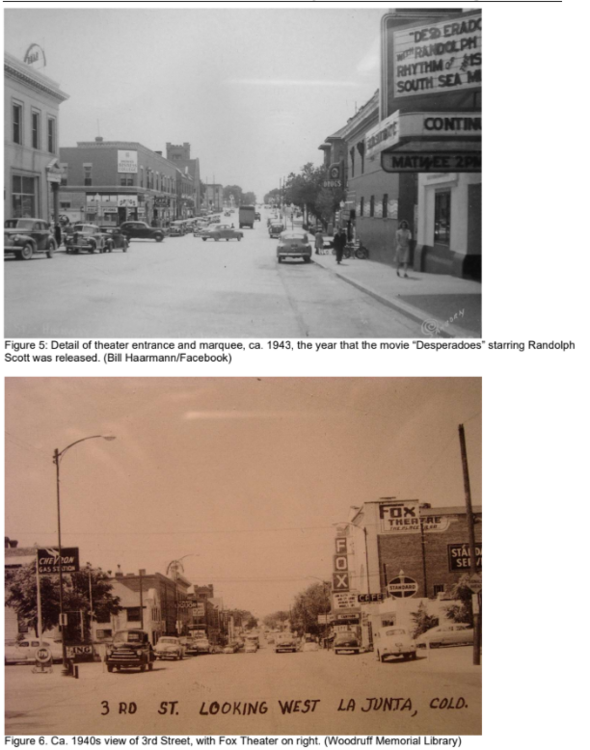
In 1929, a Western Electric Sound Projecting system was installed to "give to the people talking pictures." In addition to movies, the theater hosted other events in the 1920s and 30s, such as a fashion show featuring local stores like La Junta Dry Goods Co., Sylwood, Holbrook's, Smith's Shoes, and Montgomery Ward. In 1935 the building was officailly renamed the Fox Theater, and in 1940 Fox Theaters, Inc. purchased the building from the La Junta Theater Company.
The building is still being used as a theater and has had a recent remodel project to refresh and preserve the popular theater.
-
Information Center
-
Albera-Matlock Block 115-119 Santa Fe Ave.
-
Finney Block-Sherman House-Richert Building 13-19 W. 2nd. St
-
Central Block 114-120 Colorado Ave.
-
H.W. Potter Building 101 Colorado Ave.
-
Rourke/Fox Theater 11 E. 3rd St.
-
Standard Oil Service Station 17 E. 3rd Street
-
First Baptist Church of La Junta 7 E. 5th St.
-
La Junta Tribune-Democrat Building 418-422 Colorado Ave.
-
Woolworth's 302 Colorado Ave.
-
La Junta IOOF Lodge No. 74 14 W. 3rd St.
-
First Presbyterian Church 301 Santa Fe Ave.
-
Chestnut Building 322 Santa Fe Ave.
-
Opera House Block 215-223 Colorado Ave.
-
Lamb Building-J.C. Penney Building 214 Santa Fe Ave.
-
Commercial College Building 210 Santa Fe Ave.
-
Miller-Hale Block-Town Square Mall 208 Santa Fe Ave.
-
The Draper 202 Santa Fe Ave.
-
Malouff Block - Powell Hotel 112 W. 1st St.