Finney Block-Sherman House-Richert Building 13-19 W. 2nd. St
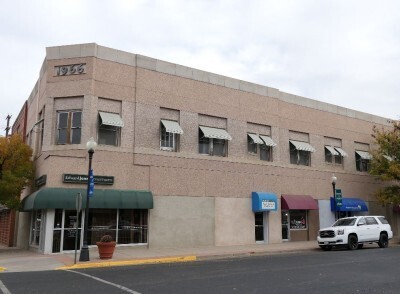
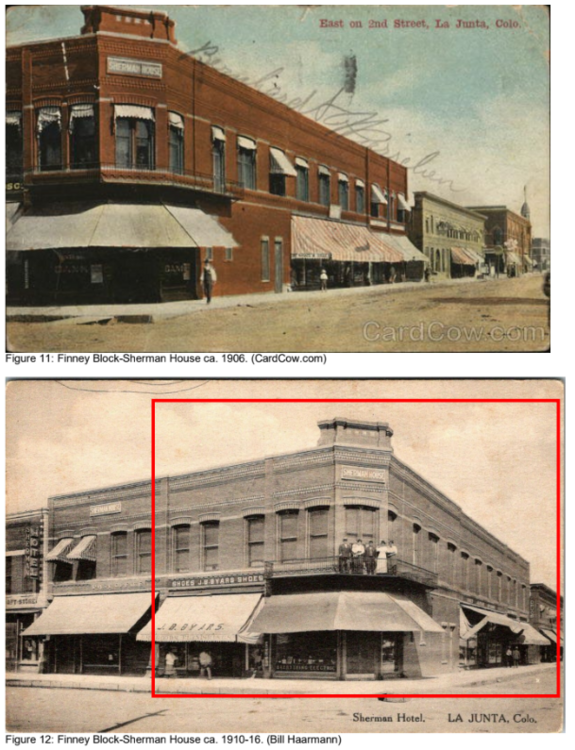
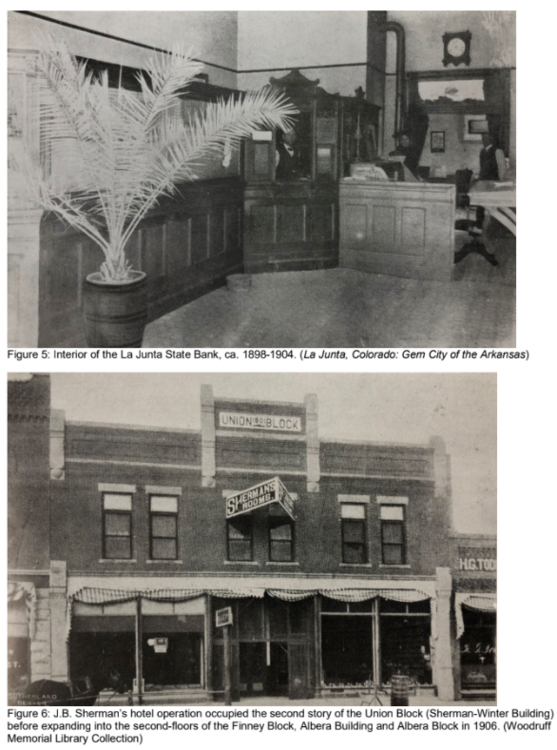
The Finney Block-Sherman House-Rickert Building was first built as a one-story commercial block in 1898, for physician Dr. Frank Finney and his wife Grace Finney. A second story addition was added in 1906 to house the Sherman House hotel. In 1966 owner Milton Rickert remodeled the building. The remodel included stuccoing the sides of the building and installing new aluminum storefronts. The building currently has a unfenestrated band of precast concrete panels topped by a limestone sill course. The windows are sheltered by fiberglass awnings that appear to date to 1966. A red brick chimney extends from the roof near the northeast corner of the building.
Dr. Frank Finney and wife Grace Finney were married 1882 and had two children. Dr. Finney and his wife moved to La Junta in 1887. They had their home at 608 Belleview Avenue built in 1899. They also owned a vacation property in Palmer Lake and a ranch outside La Junta. Dr. Finney was employed by the Santa Fe Railroad and was relocated to La Junta to run the hospital that was opend in 1884. In 1907-1908, he oversaw the construction of a new Santa Fe Hospital in La Junta and continued to serve as superintendent. He also had a successful private practice, was a real estate investor and influential in La Junta's city development.
Milton Richert was born and raised in La Junta. He was a lawyer and his parents owned the La Junta State Bank. Richert purchased and remodeled the entire block in 1966.
The ground floor occupants included a jewerly store, clothing merchants, drug store and a dry goods emporium. T.M. Finney, Frank Finney's brother, opened a novelty store with kitchenware, stationary and school supplies. The State Banks original location was on the corner where Edward Jones is currently located. The bank moved to the Simonton Block on the corner of Second and Colorado where it is currently. This location also had aan electrical supply business, and an upscale clothing store. When the clothing store expanded they moved to 3rd and Santa Fe.
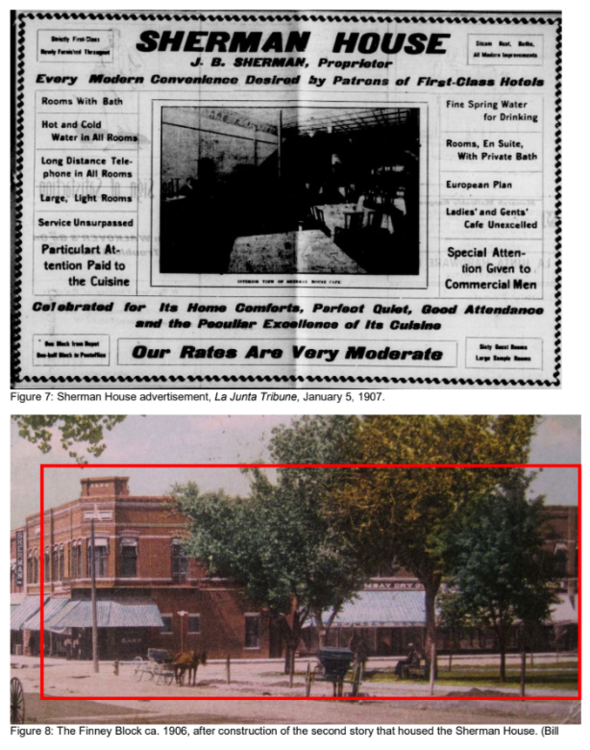
In 1906 when Finney worked with Victor Albera to construct the second story of this building and the building to the north, this in turn allowed the original Sherman House to expand. This addition allowed the hotel to increase in size. A hotel of this size was considered similar to those seen in large cities and coatered to travelers, tourist and traveling medical professionals who would see local patients in the hotel. The hotel operated until the 1950s when it was replaced with forty "long term basis" rental apartments.
-
Information Center
-
Albera-Matlock Block 115-119 Santa Fe Ave.
-
Finney Block-Sherman House-Richert Building 13-19 W. 2nd. St
-
Central Block 114-120 Colorado Ave.
-
H.W. Potter Building 101 Colorado Ave.
-
Rourke/Fox Theater 11 E. 3rd St.
-
Standard Oil Service Station 17 E. 3rd Street
-
First Baptist Church of La Junta 7 E. 5th St.
-
La Junta Tribune-Democrat Building 418-422 Colorado Ave.
-
Woolworth's 302 Colorado Ave.
-
La Junta IOOF Lodge No. 74 14 W. 3rd St.
-
First Presbyterian Church 301 Santa Fe Ave.
-
Chestnut Building 322 Santa Fe Ave.
-
Opera House Block 215-223 Colorado Ave.
-
Lamb Building-J.C. Penney Building 214 Santa Fe Ave.
-
Commercial College Building 210 Santa Fe Ave.
-
Miller-Hale Block-Town Square Mall 208 Santa Fe Ave.
-
The Draper 202 Santa Fe Ave.
-
Malouff Block - Powell Hotel 112 W. 1st St.