

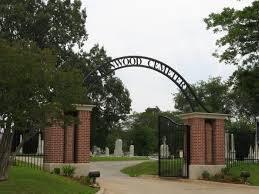
Follow the zig-zap pattern of Padon St, moving west and discover Greenwood Cemeter at 705 Magrill. One of Longview’s most important historic places, serving as the final resting place for many of the city’s founders, pioneers, veterans, and prominent citizens. A drive through its shaded grounds offers a powerful glimpse into the people and events that shaped Longview from its earliest days.
In 1877, J. M. Cornes purchased four acres on this site and, with county surveyor A. S. Taylor, established what was first called the Longview Cemetery. It sat just outside the city limits, immediately north of a railroad junction subdivision platted a few years earlier by the International and Great Northern Railroad. The cemetery expanded in 1884 when Cornes and Taylor acquired additional land to extend it to Magrill Street. The original layout provided room for an estimated 3,392 graves, not including a Potter’s Field.
Many of the earliest settlers in the area were brought here as well. Most remains from the Pioneer Boring and Leake Cemetery, located near what later became the east end of College Street, were reinterred at this site. The earliest headstone from that earlier cemetery is Louisa Stroud, who died in 1856. The earliest marked grave originally buried here is believed to be Ida Denny, who died in 1878. In 1905, the cemetery was renamed Greenwood, the same year it was incorporated into the city limits.
Greenwood holds deep military history, including the grave of a War of 1812 veteran and 37 known Confederate veterans. It is also tied to some of the region’s most dramatic stories, including the graves of three people killed during the infamous 1894 robbery of the First National Bank of Longview by the Dalton Gang, as well as members of a family who perished in the 1900 Galveston storm.
Many of Longview’s most significant leaders are buried here, including O. H. Methvin, known as the “Father of Longview,” who deeded 150 acres to the Southern Pacific Railroad for the townsite. Also interred here are Bluford W. Brown, the state legislator who helped secure the creation of Gregg County, and Britton Buttrill, who operated the Earpville stagecoach stop and later became a founding commissioner and the first treasurer of Gregg County.
Today, Greenwood Cemetery stands as a true chronicle of Longview’s history, preserving the stories of those who built the community and those whose lives became part of its legends.