Stop 6: The Whig Party and the Election of 1844
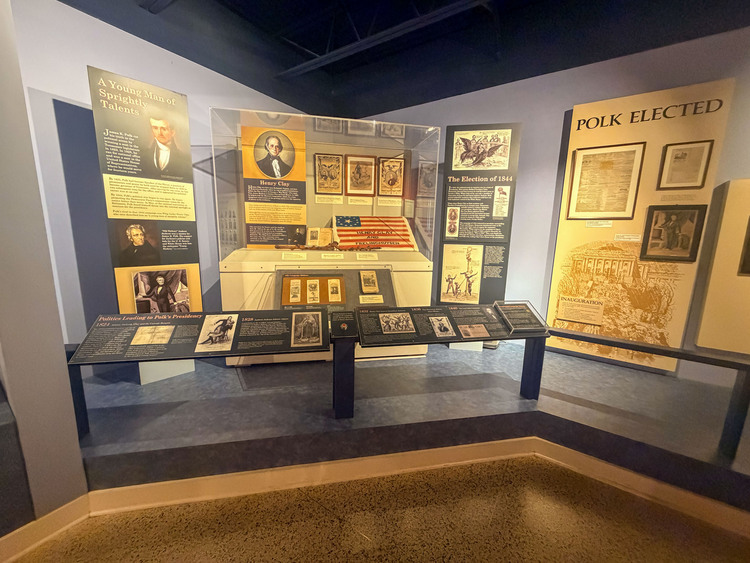
Henry Clay, leader of the Whig Party, found himself running unexpectedly against former Speaker of the House and Tennessee Governor, James K. Polk, in the 1844 election for President of the United States. Clay opposed annexing Texas, believing that it would intensify chaos in an already tense relationship and lead to war with Mexico.
Originally, former President Martin Van Buren was the Democratic nominee, but Van Buren was not as pro-slavery or pro-expansion as other leaders within the Democratic Party. Van Buren’s views did not align with the majority of the Democratic Party, and James K. Polk emerged as an unexpected candidate.27 As former Speaker of the House during Van Buren’s administration, Polk was not an unknown figure, but perhaps a surprising last-minute choice for a candidate since Polk had recently lost the last two gubernatorial races in Tennessee. Correctly judging the public’s desire to annex Texas, Polk won the 1844 presidential race, securing 170 electoral votes to Henry Clay’s 105 electoral votes.
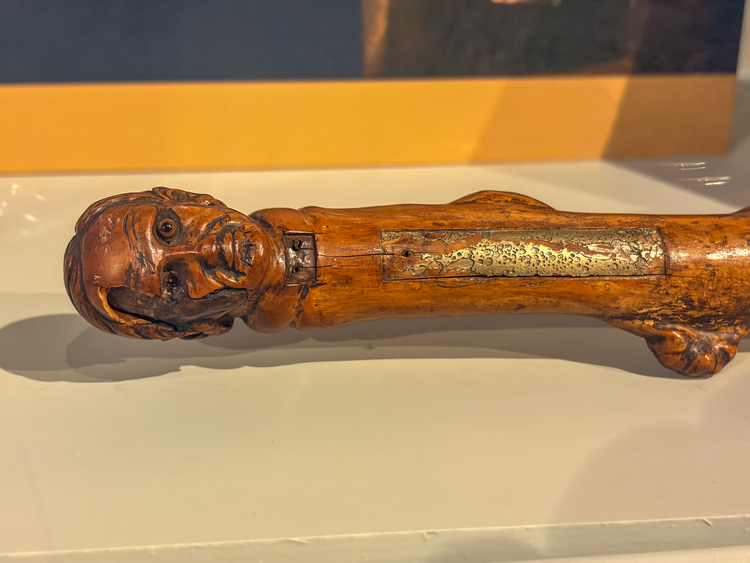
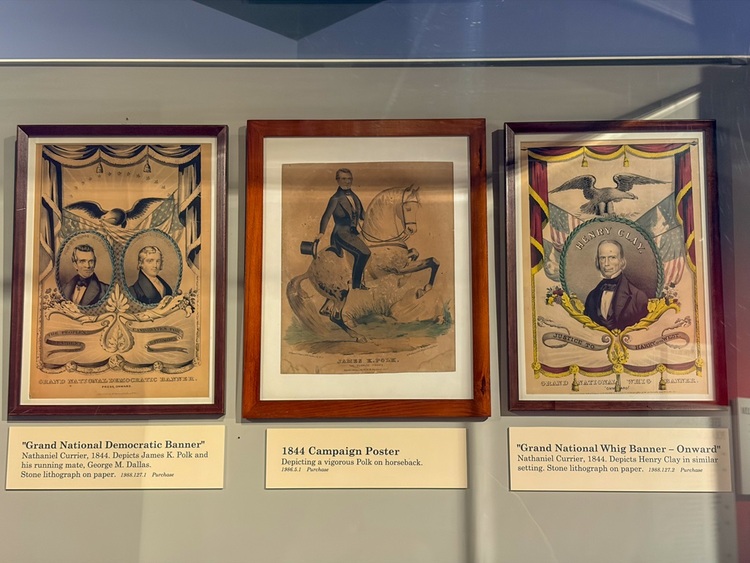
In the case in front of you is Henry Clay’s cane, featuring his own likeness carved into the handle. In the back of the case are campaign posters. The one on the left illustrates James K. Polk and his running mate, George Dallas. The middle depicts James K. Polk riding a horse, and the poster farthest to the right is Henry Clay.
The Whig Party formed in the 1830s out of smaller political factions united against Andrew Jackson’s administration. Jackson, the first Democrat President, favored states' rights, western expansion, a decentralized banking system, and tariffs to protect emerging American industries. The Whigs also opposed the Jacksonian era policies of what we now call The Trail of Tears, which was the forced removal of Indigenous people from their native homelands to the area west of the Mississippi.
The Whigs opposed Jackson’s policies and saw Jacksonian power as an abuse of the executive office. The Whigs were at odds with the Democratic Party who pushed for the expansion of both slavery and US territory.23
A series of Congressional acts and compromises that took place in the first half of the 19th century protected and allowed the expansion of slavery in new states. Whigs and Democrats struck a series of compromises over several decades to maintain a shaky political truce. As the US expanded, the issue of slavery also expanded. The Missouri Compromise of 1820 prohibited slavery north and west of Missouri. As free states and slave states sought to maintain a political power balance between their two differing ideologies, the question of annexing the failing Republic of Texas into the US as a slave state, threatened to skew the power balance. 25
The next stop will be in front of the red, square sign labeled #7, in front of the wall that says “President Polk.” Scan the QR code, or press next on your device.
-
Introduction
-
Stop 1: American Indian and Catawba Nation
-
Stop 2: Life on the Polk Farm
-
Stop 3: Childbirth
-
Stop 4: Southern Cotton
-
Stop 5: The Spirited Age: 1820-1850
-
Stop 6: The Whig Party and the Election of 1844
-
Stop 7: James K. Polk’s Presidency
-
Stop 8: War with Mexico
-
Stop 9: Santa Anna versus the new state of Texas