

Arctic Fox
The Arctic Fox – Vulpus lagopus;
MEET OUR ARCTIC FOXES
BUDDY and JOVIE
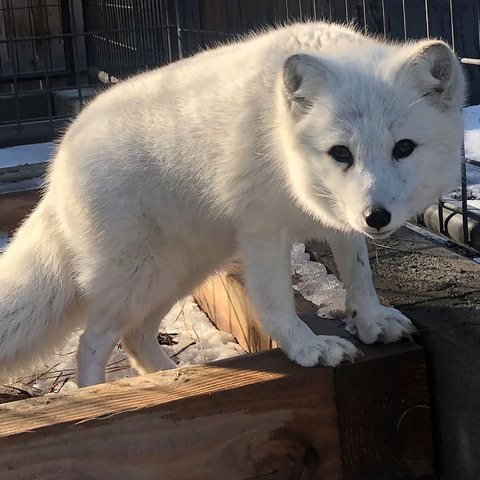
Buddy and Jovie came to live at Cat Tales in March of 2020. They are Arctic Foxes and when they first arrived, they had their full white winter coats. During the summer they shed their white fur and are a dark brown grey. They are the smallest of the fox species and when not curled up sleeping, they are very active in their new fox designed exhibit. Though it is hard to tell, both foxes have special qualities. Buddy is a bit hard of hearing and Jovie is cross-eyed in both eyes. We are learning more and more about their behavior every day, watching the similarities to the red foxes and the behaviors that make them arctic unique. Born June 2019.
ABOUT THE ARCTIC FOX
Habitat: Arctic foxes live north of the tree line in the Arctic and alpine tundra, coastal areas, and on ice floes.
Lifespan: In the Wild, 3 – 6 years; In Captivity, 8 – 10 years;
Diet: Omnivore;
Status: Stable;
The arctic fox is an incredibly hardy animal that can survive frigid Arctic temperatures as low as –58°F in the treeless lands where it makes its home. It has furry soles, short ears, and a short muzzle—all-important adaptations to the chilly clime. Arctic foxes live in burrows, and in a blizzard, they may tunnel into the snow to create shelter. Arctic foxes have beautiful white (sometimes blue-gray) coats that function as very effective winter camouflage. The natural hues allow the animal to blend into the tundra’s ubiquitous snow and ice. When the seasons change, the fox’s coat turns as well, adopting a brown or gray appearance that provides cover among the summer tundra’s rocks and plants. These colorings help foxes to effectively hunt rodents, birds, and even fish. But in winter prey can be scarce on the ground. At such times, arctic foxes will follow the region’s premier predator—a polar bear—to eat the leftover scraps from its kills. Foxes will also eat vegetables when they are available. Like a cat’s, this fox’s thick tail aids its balance. But for an arctic fox the tail (or “brush”) is especially useful as warm cover in cold weather. Female arctic foxes give birth each spring to a large litter of up to fourteen pups.
-
The Story of Jack Spriggins and the Enchanted Bean
-
Sun, Moon, and Talia
-
The Enchanted Frog
-
The Queen's Croquet-Ground
-
Nenillo and Nennella
-
Blackbeard's Ghost
-
The True History of Little Golden-Hood
-
The Dullahan
-
Three Sisters
-
The Mirror of Current Events, or Beauty to the Highest Bidder
-
The Legend of Saint Galgano