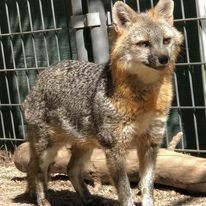
Northern Gray Fox
The Northern Gray Fox – Urocyon cinereoargenteus;
MEET ROXY OUR GRAY FOX
Roxy arrived in April 2021 with other animals in need of a retirement home that could provide them with quality of life in their final years. We are learning a lot about the species of Gray Fox and how their behaviors differ from the others. Being an older animal we are keeping a close eye on her comfort and quality of life, providing for her geriatric needs. Born 2011.
Habitat: North, Central, and Northern South America. Gray foxes prefer deciduous forests which incorporate brushy, woodland areas.
Lifespan: Wild 6-8 years; Captivity 8 – 10 years ;
Diet: Omnivore;
Status: Least concern;
Also called the tree fox, this long-bodies species prefers woodland. It climbs skillfully, leaping up tree trunks and between branches with almost cat-like ability. Active at night, it consumes various insects and small mammals, but may rely more on fruit and seeds in certain seasons. The Northern gray fox has a small, dark-gray neck mane and central back stripe, and a red tinge to the neck, flanks and legs, with a buff or white chin and belly. The speckled or grizzled coat is due to individual hairs banded in white, gray, and black. Long, bushy tail with a black dorsal stripe and tip. Gray foxes can run up to 45 miles per hour.
Inhabits temperate and tropical forests, woodland, brush, semi-arid scrubland, agricultural habitats and peri-urban areas. Avoids very open areas such as grassland and prairie. Its den may be in an old burrow or log, but more often in a tree hole up to 30 feet (9 m) above ground, or on a building ledge or in a roof space. Most gray foxes live as breeding pairs.
Mating occurs January-April with a gestation of 60-63 days. The average litter size for the Northern gray fox is 4 (ranging from 1-10). Each new-born cub is black-furred and, like most foxes at birth, helpless with eyes closed. Its eyes open at 9-12 days and by 4 weeks ventures from the den and begins to climb, guarded by the parent. It starts to take solid food 2 weeks later.
-
The Story of Jack Spriggins and the Enchanted Bean
-
Sun, Moon, and Talia
-
The Enchanted Frog
-
The Queen's Croquet-Ground
-
Nenillo and Nennella
-
Blackbeard's Ghost
-
The True History of Little Golden-Hood
-
The Dullahan
-
Three Sisters
-
The Mirror of Current Events, or Beauty to the Highest Bidder
-
The Legend of Saint Galgano