Red Fox
MEET OUR RED FOXES
TODD AND TRIXIE
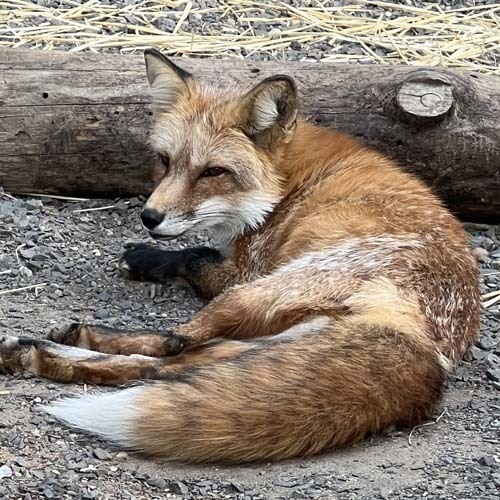
Todd and Trixie are siblings. Part of our smaller canine family they continue to educate us about the dynamics of male and female foxes. They live together (Todd is neutered) and spend most of their time digging holes, climbing on their furniture to watch everyone and everything, or having tiny play fights against one another. Squabbling can get noisy at feeding time, but it is just Trixie reminding Todd that it is Ladies First. You can tell them apart by their markings — Trixie has a very dark face, tail, and legs while almost all of Todd’s body is the classic fox color of reddish orange. Born on April 6, 2019.
KALI
Kali, short for Kalispell, came to Cat Tales as a young kit in the spring of 2018. She arrived with several other animals, two of which were coyote pups around the same age. But despite her seemingly compatible pup friends, after a brief introduction, it was clear that Kali would like to live alone, as is typical of a red fox. Kali grew very quickly and though you would never know it, she is missing a toe on her right front foot. Kali is extremely energetic and loves to have space to climb and throw her toys around. Foxes are known to constantly dig holes and hide food and other treasures. When the time is right, they will dig it up or scent mark it for later discovery. Just one of the ever-fascinating fox behaviors to see! Born March 30, 2018.
JASPER AND JINX
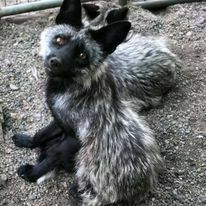
Jasper and Jinx are our two young silver foxes, a melanistic variation of the red fox that displays wild pelt variations from pure black to blue-grey, or silver spotted. These two came to Cat Tales in early June 2019. Beyond learning to be good brothers to one another, they have also become fond of their neighboring fox kits Trixie and Todd. But most of all they enjoy being together no matter the weather, time, or event. Jinx is almost purely silver, a shining fox who spends most of his day curled up napping or ‘gekkering’ (a sharp, barking sound) at nothing in particular. (Jinx also has a genetic deformity in his front legs, though it does not affect his behavior.) His brother, Jasper, is more curious about the world and will watch staff and guests alike. He is also not as silver as his brother, with quite a few patches of black across his fur. Born April 15, 2019.
Habitat: North America, all regions;
Lifespan: In the Wild, 2 – 4 years; In Captivity, 8 – 10 years;
Diet: Omnivore;
Status: Least concern;
The red fox makes its home in wooded areas, prairies and farmland. It has a reddish coat that is white underneath and a big bushy tail with a white tip. Red foxes are not all red. Some are brown, some are black and others are silver in color. Even foxes that come from the same litter can be different colors! Red foxes live in family groups and are known for their cleverness and ability to adapt to different surroundings. They are usually active at night. During the day, they rest in forests, or ravines, curling their long bushy tails around themselves to keep warm. Red foxes have excellent vision, and keen senses of smell and hearing. They can make 28 different types of calls to communicate with each other!
The red fox is a lean hunting machine that’s built for speed. It is slinky and long legged and about the size of a small dog. The red fox stalks its prey, much like a cat. It gets as close as it can and then pounces on its prey. Its diet includes fruits, berries and grasses. It also eats birds and small mammals like squirrels, rabbits and mice. A large part of the red fox’s diet is made up of crickets, caterpillars, grasshoppers, beetles and crayfish.
Red foxes are not under threat anywhere because of their ability to cope well around humans. They are not considered to be endangered and are the most widespread and abundant wild carnivores in the world.
The red fox will continue to hunt even when its tummy is full. It stores the extra food under leaves, snow or dirt, to be eaten later.Red foxes have large, upright ears and their hearing is so sharp that they can hear a watch ticking 40 yards away.A red fox’s tail is about one third of its length. It is used as a warm cover in cold weather and as a signal flag to communicate with other foxes.The male red fox is called a dog, while the female is called a vixen. A young fox is called either a ’Kit’, ’Pup’ or ’Cub’. A group of foxes is called a ’Skulk’.
-
The Story of Jack Spriggins and the Enchanted Bean
-
Sun, Moon, and Talia
-
The Enchanted Frog
-
The Queen's Croquet-Ground
-
Nenillo and Nennella
-
Blackbeard's Ghost
-
The True History of Little Golden-Hood
-
The Dullahan
-
Three Sisters
-
The Mirror of Current Events, or Beauty to the Highest Bidder
-
The Legend of Saint Galgano