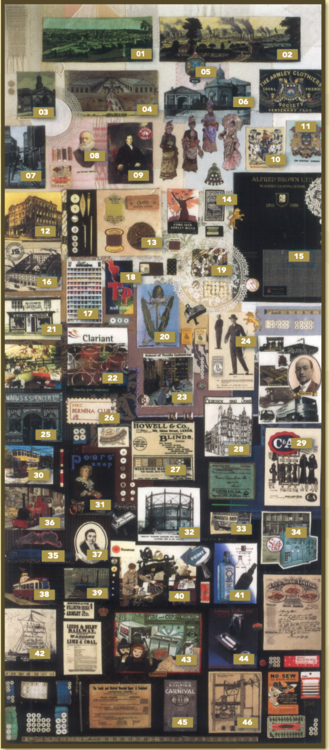
Pins & Needles
This panel, titled "Pins & Needles," is a tribute to the rich textile and industrial heritage of Leeds. Each embroidery featured on the panel illustrates a business, location, or object that is significant to the history of Leeds, particularly its longstanding connection to textiles and various industries. The background of the panel is thoughtfully designed by Kate, who chose to use lightweight fabrics at the top and heavier ones at the bottom. Her intention was to symbolize domesticity and the textile tradition with the light fabrics, while the heavier textiles at the base evoke the strength and importance of industry, thus merging both themes seamlessly within the artwork.
On the middle left of the panel, there is a detailed depiction of an early Marks & Spencer store, specifically store number 25. The beginnings of Marks & Spencer trace back to Leeds, where Michael Marks, a Polish Jewish immigrant, partnered with Tom Spencer, a local mill cashier. Their venture began in Kirkgate Market, but the store shown here is from Edgeware Street in London, possibly because that image was more readily available. Just above this, Bond’s Haberdashery in Farsley is represented twice—once from the outside and once inside, showing Mr. and Mrs. Bond surrounded by a treasure trove of sewing supplies. Bond’s notable support of the Tapestry project likely earned them this special recognition.
The panel also incorporates antique haberdashery items donated by volunteers, such as a delicate doily in the top left corner from Margaret Clarke, passed down from her great aunt born in 1860. Margaret also contributed sewing box items from her mother, including linen buttons and spools of thread. In the lower center, there is a whimsical scene of a fish and chip shop with a fryer by Hopkin’s Catering Equipment. The scene, inspired by local life, shows a couple dressed up for a night out, stopping for fish and chips, with some artistic liberties taken for effect.
On the right, an old advertisement for C & A clothes is displayed, a European brand that operated in the UK from the 1920s until the early 2000s. To the left and slightly above, a Peacock’s store is depicted, representing the early 19th-century textile company known for curtains, bedding, and carpets. This section was embroidered by Mary Mawson, who once worked at Peacock’s and remembers them fondly. Below Peacock’s, a blue gin bottle made by Lax & Shaw, a Leeds glass company established in the 1890s, is shown. Once known for baby bottles, Lax & Shaw later specialized in colored glassware like the Sapphire gin bottle.
At the very top, two historical paintings of Leeds are featured. On the left, “Prospect of Leeds From the Knostrop Hill” (c. 1715), and on the right, a view from Rope Hill by Alphonse Douseau in the 1840s. Together, these artworks dramatically reveal the city’s transformation, with far more industrial chimneys in the later scene, illustrating the profound impact of industry on Leeds over time.