

As you walk south on 10th Street, think not only of the restaurants, shops, merchandise, and crowds that make Chinatown photogenic, but also of the community institutions that have deliberately cultivated a presence here and the housing they have built. The Philadelphia Chinatown Development Corporation, in particular, has repeatedly leveraged outside resources from government and private investors to plan and develop Chinatown, To a certain extent, PCDC has wrested control of the redevelopment process away from the city government. But it has also had to cooperate with the city in order to obtain funding, sites, and permits.
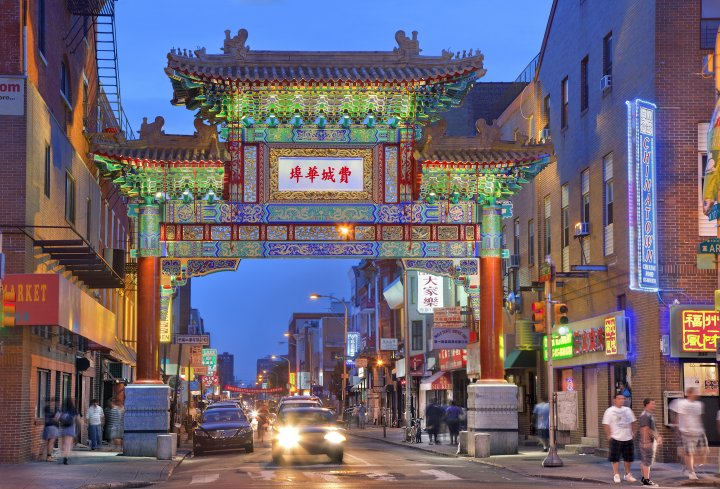
At the intersection of Arch Street, you will encounter what was, at the time of construction in 1983-84, the largest Chinese gate in the United States. Built by a company of Chinese artisans who had also done restoration work in Beijing, the 40-foot-high, 88-ton structure commemorated a trade agreement made between Philadelphia and Tianjin, a major port city in China. Chinese-American residents of Philadelphia traveled to China to participate in the trade negotiation, and the city paid for the gate, hoping it would draw tourists into Chinatown. The Philadelphia Chinatown Development Corporation (PCDC) saw the gate as a distraction from its interests in building housing, but it agreed to participate because the city was eager and because it was thought that the gate would help improve Chinatown's public image. It was deliberately placed in this location, on the southern edge of Chinatown, to signal the neighborhood's presence to visitors coming from the Market East development and points south. (Contrary to the tourist narrative, on this tour we have entered Chinatown from the east, and we'll exit through the gate!)
At the time the gate was developed in the mid 1980s, 400 people were on the waiting list for senior housing at the 55-unit On Lok House, which was then under construction. The controversy over this decision may resonate with you even today. Do you think it was appropriate for the city to put its resources into a symbolic gate in that context?
Source: Wilson, K. (2015). Ethnic Renewal in Philadelphia's Chinatown: Space, Place, and Struggle. Temple University Press.
Image source: Encyclopedia of Greater Philadelphia