

Walk south on 10th Street to the corner of Spring Street. You are entering the heart of the more touristic part of Chinatown. Many signs and symbols tell you that this is an area that broadcasts its identity to the visitor, including inlaid brass plates on the sidewalk depicting animals of the Chinese zodiac, the restaurant signs and merchandise displayed on the sidewalk, and Chinese architectural motifs on the buildings. However, this location is not only a tourist attraction, but also the symbolic heart of the Chinatown community: the very center of the four square blocks depicted as Chinatown on the Yellow Seeds protest flyer we saw earlier. Another venerable Chinatown religious institution, the Chinese Christian Church, sits on the northeast corner. Religious and social institutions clustered in this area, like the church you see here, Holy Redeemer, and the Tsung Tsin Association attract members of Chinese descent not only from the immediate neighborhood, but from throughout the metropolitan area.
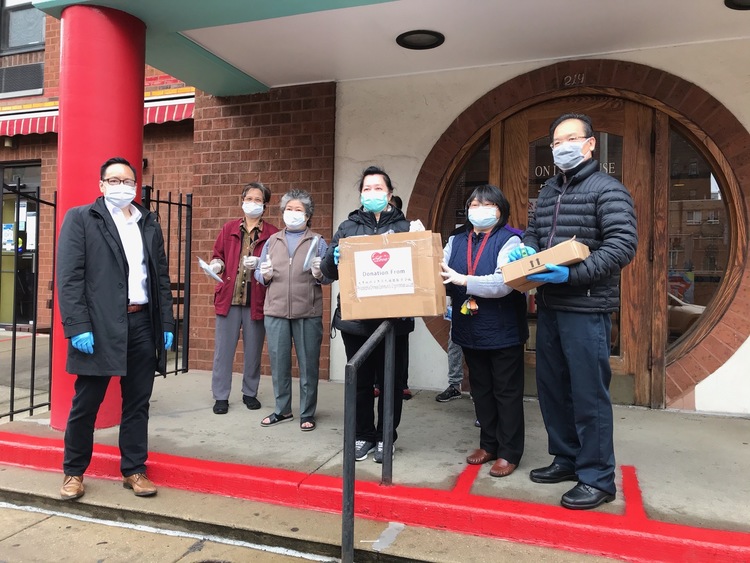
The Philadelphia Chinatown Development Corporation (PCDC) reinforced the centrality of this intersection for Chinese residents when in the 1980s it redeveloped the southeast corner of the intersection, which had been the site of a paper company, with an affordable senior housing complex called On Lok House. Built with funding from the U.S. Department of Housing and Urban Development (HUD), this development offers 55 apartments designated for low-income seniors as well as a senior community center. Decorative motifs such as the circular entranceway reinforce the Chinese identity of this project.
Other infill PCDC housing developments of the late 20th century can be found in the surrounding blocks. These small-scale projects, also built with government financing, were designed to reinforce the existing character of the neighborhood while providing modern housing.
In the attached photo, community members delivering masks to On Lok House during the coronavirus pandemic pose outside the front entrance to the building. Considering not only its Chinese motifs, but also its overall design, what does the architecture of this building contribute to the neighborhood's identity? What other design choices can you see in this immediate area that reinforce a sense of community? How do these design choices differ from those we saw in the urban renewal projects at the beginning of the tour?
Image source: Philadelphia Chinatown Development Corporation