

Surveyor Thomas Holme (1624-1695) and Pennsylvania founder William Penn (1644-1718) conceived the idea for a gridded city punctuated by garden squares in the 1680s. They drew inspiration from baroque town planning, post-Great London fire (1666) concerns for city health, desires to compensate initial investors in Pennsylvania with land, and personal preferences of Penn and early interest groups such as the Free Society of Traders. You are now standing in one of the original five squares, now known as Franklin Square.
The city did not grow as Penn anticipated, and development initially crowded near the Delaware waterfront, far from the squares. Further inhibiting the development of Franklin Square in particular was its poor drainage. In 1741, William Penn's son Thomas agreed to lease a portion of the square to the German Reformed Church for a cemetery. Eventually, as the urban area spread around the original squares, the city sought to use them as public parks. The church refused to vacate its cemetery, but it was covered with a layer of dirt and forgotten. The city installed a fountain in the square in 1838.
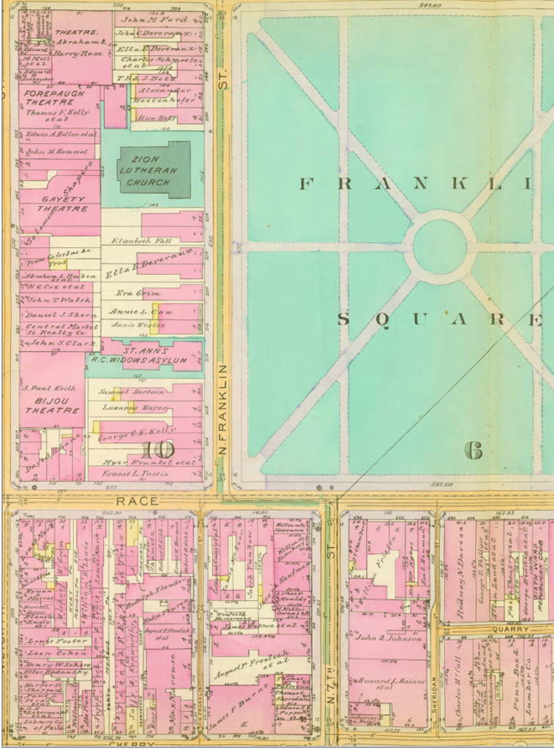
Although for a time it was surrounded by fashionable residential development, by the late 19th century, the area had been commercialized into the city's Tenderloin district, an area populated by theaters, pool halls, saloons, brothels and gambling hotspots. The image above shows the urban pattern on the west side of the square circa 1921. With few others claiming the space, it became a refuge for impoverished single men who often spent the night in nearby rooming houses. They socialized and used drugs and alcohol in the square by day. Despite the square's unsavory repuatation, in 1961, the noted urban observer and critic Jane Jacobs wrote that Franklin Square was a successful urban park, describing it thus:
"In Franklin Square, if the weather permits, a day-long outdoor reception holds sway. The benches at the center of the reception are filled, with a voluble standing overflow milling about. Conversational groups continually form and dissolve into one another. The guests behave respectfully to one another and are courteous to interlopers too. Almost imperceptibly, like the hand of a clock, this raggle-taggle reception creeps around the circular pool at the center of the square. And indeed, it is the hand of a clock, for it is following the sun, staying in the warmth. When the sun goes down the clock stops; the reception is over until tomorrow."
Gradually even this population left Franklin Square as urban renewal brought large-scale demolition to the area, shutting down the nightspots and rooming houses and isolating the square with highway ramps. The city sought to revive Franklin Square in the early 2000s by contracting out its maintenance to Historic Philadelphia, a nonprofit that also oversees the Besty Ross House and storytelling benches within the city's historic district. The organization converted it into a family-friendly tourist attraction with a carousel, miniature golf course, and a food stand. It now attracts 1 million tourists a year.
Sources: John Kopp, "Franklin Square: Philly's Forgotten Park Morphs into Modern Attraction," Philly Voice, July 11, 2017.
Catharine Dann Roeber and Charlene Mires, "Center City," The Encyclopedia of Greater Philadelphia.
Image source: Elvino Smith, Atlas of the 6th, 9th, & 10th Wards of the City of Philadelphia (1921).