

Walk across Independence Mall to 6th and Arch. The green that you have been walking on covers an underground parking lot designed to provide parking spaces for tourists visiting the Independence Visitor Center, the National Constitution Center, and other attractions. One of the major goals of urban renewal in this area was to make it easy and safe for suburbanites and tourists to access the museums, shopping, and offices that would be provided in Center City, and if you examine the urban renewal plans from the mid 20th century you will see that a high priority was placed on convenient vehicular access.
Note that 6th Street is a wide, one-way southbound artery in this location. The underground parking lot entrance just south of this intersection is only a few hundred feet south of ramps connecting the surface street network to the regional highway system. For a traveler exiting the Vine Street Expressway (I-676) onto 6th Street southbound, this is the first parking lot entrance they would encounter. This makes it possible to visit the attractions without needing to negotiate city streets--an explicit goal of the urban renewal planning in the 1960s.
Across 6th Street from the Independence Visitor Center and the National Constitution Center are two more urban renewal projects--two major federal office buildings flanking both sides of Arch Street. The building on the north is the Federal Reserve Bank of Philadelphia, and the one on the south houses office space for federal agencies including the Internal Revenue Service (IRS) and the Federal Bureau of Investigation (FBI). Note the contrast in the landscaping between the heavily fortified perimeters of these buildings and the open green that you have just left. What message does this design choice send? What does it suggest to visitors and residents about the blocks to the west of here?
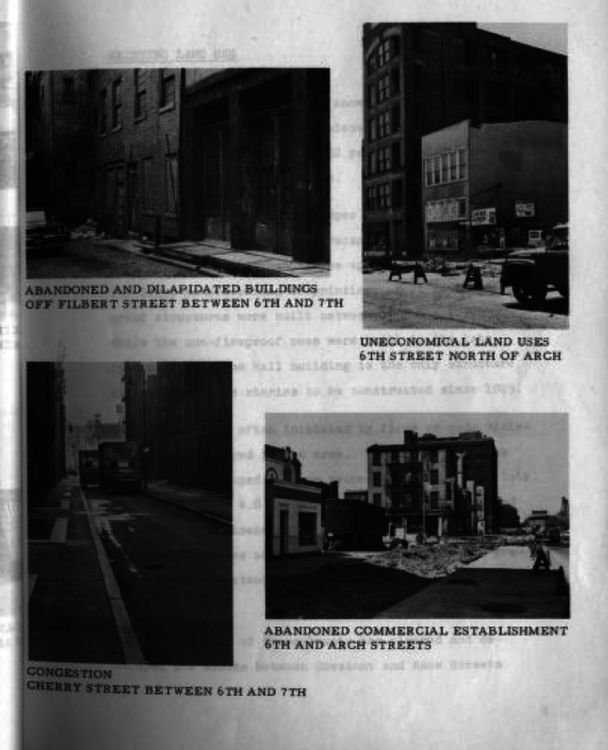
As you continue this tour, you will observe that several large Institutions associated with state power and security have occupied the blocks between Independence National Mall and Chinatown. This was the result of a deliberate decision made to completely replace the pre-existing built fabric of old commercial buildings, which were considered uneconomical, abandoned, and dilapidated, as indicated in the image from the redevelopment plan shown here.
Image source: Independence Mall Redevelopment Area Plan, 1962