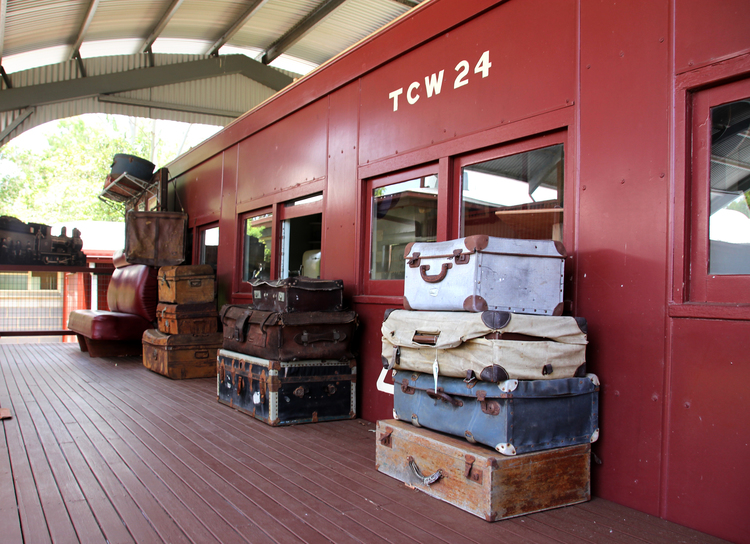
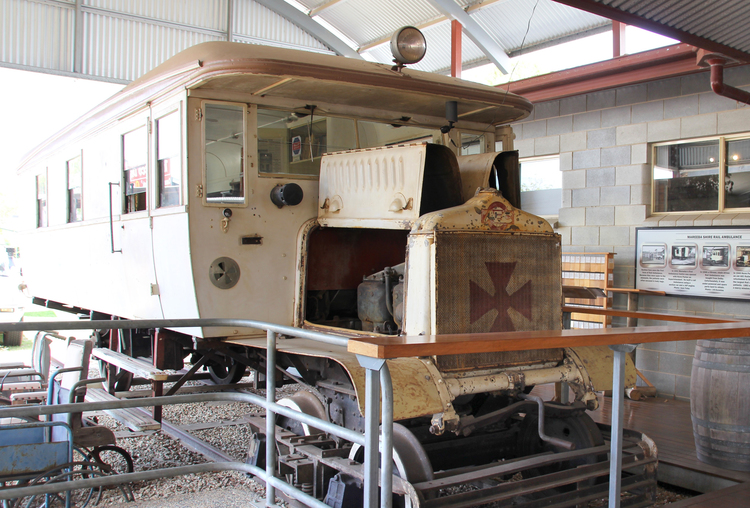
The rail camp car and siding, exhibit number 19, introduces the story about how the railway came about.
As the mines and businesses, became established, the people began to petition the government for easier transport routes.
Wheeled vehicles, had to be hauled up the mountains from Cairns, and in the wet, any type of transport was delayed, or cancelled due to bogging. These problems meant it was difficult to provision the mines, and get the minerals to Port.
Trains had become increasing popular, and useful across the western world, and in the southern states. In 1886, the Queensland Government commissioned, Christie Palmerston, to identify a track for a possible railway line, from Herberton to Port Douglas, and the growing settlement at the nearest point with the best Port, in Cairns.
Palmerston found several potential tracks, including a track along the remnants of the range, to Port Douglas; a second winding through the mountains, dividing the Tableland from the coast, and down to Cairns; and a third, branching off before reaching Mareeba, and going down the mountains, to a settlement called Geralton, which was later to become Innisfail.
The Government surveyor, settled on the track leading from Mareeba to Cairns.
The building of the railway line, was contracted out in three sections. The first, from Cairns to the bottom of the range. The second, and most difficult, was from the foot of the range, and up to Myola. This section, was led by John Robb. The third, and final section, was led by William Sutherland, from Myola to Mareeba.
Many nationalities assisted in the construction, in particular Irish, and Italian immigrants. These workers, had to supply their own tools and shovels.
The railway track, reached the settlement in 1892, and that year, it was proclaimed a town, and formally named “Mareeba”.
The name Mareeba, is a local First Nations word, meaning ‘meeting of the waters’, celebrating the junction of the Barron River, and Granite Creek, just to the north east of the town.
Many of the railway builders, stayed to work on the railway, to build and add extensions, from Mareeba to other settlements.
Thus began a period, during which Mareeba, was primarily a railway town, sending trains to the mine fields, and down to the Ports.
At the same time farmers established themselves, to provide food for the mines, and the busy Port towns, using the railways to get their goods to market.