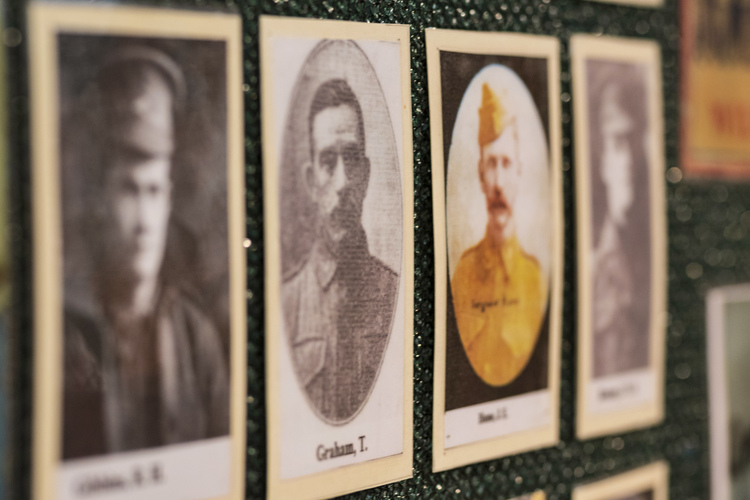
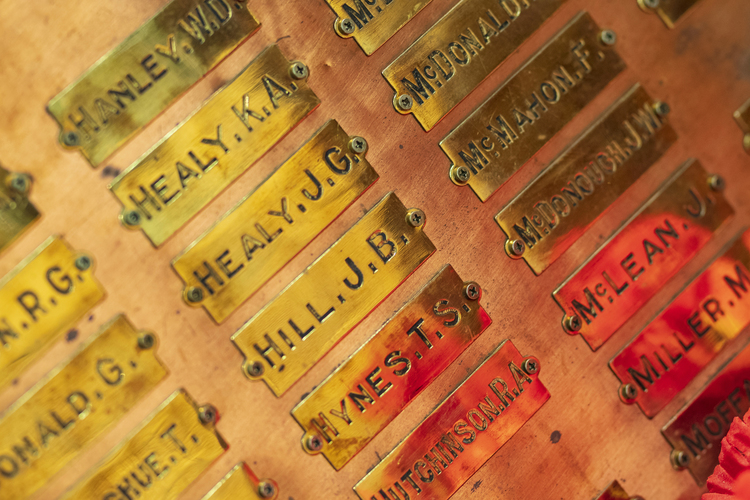
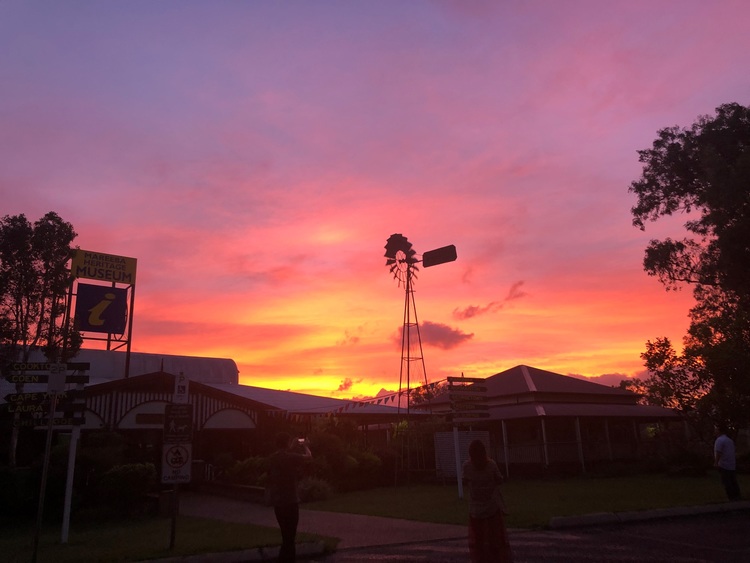
In the eighteen nineties, when they had the shearers strikes, they sent the Light Horsemen to keep order.
The Light Horsemen, in their spare time, chased emu’s for fun. Emu’s can run at 35 miles per hour. If the horsemen could lean off their horse, and grab a handful of feathers, they earned the right to wear feathers in their hat.
When they went to war, all the Queenslanders wore emu feathers. The other Australian States and Territories said, ‘We want emu feathers too’, and the reply was, ‘Go home and chase your own bloody emu’s’. But they said, ‘We’ll pay, we'll pay’. So the Queenslanders wrote home, to ask for emu feathers to be sent, because they were making an awful lot of money.
The Australian Light Horsemen wore emu feathers, but told everyone that they were 'kangaroo' feathers.
Everyone believed them!
The Light Horsemen were happy to give the Scott Highlanders feathers, as they were considered the best horsement. But, the Scott’s hierarchy wouldn’t let them.
It was only the Australians who wore the 'kangaroo' feathers.
Private Jack Leswell, from Mareeba, was a Light Horseman. He died, in World War I, on 15th October 1916. After he died, his Captain, wrote to his mother.
Dear Mrs Finn,
As I was with your lad, Jack Leswell, when he died, I thought you may like to hear about it. He was wounded through the back with a bullet, it went in just above the left shoulder blade and came out under the right, probably injuring the spine in its course.
He was climbing up a steep rocky hill, chasing the Turks away, from the positions, and his mates carried him down. I rode over from another part of the field, and met him at the bottom of the gully. He was quite bright, and although there was suffering from pain, he appeared cheerful and spoke to us all.
We bandaged him up, and after some delay, got a camel, with a sort of bed on its back, which we use for transporting the wounded in the desert, when no wheeled vehicle can. The poor lad suffered a great deal, on this journey, to the field ambulance, and everyone there tried to ease his pain, by steadying the bed on the camel. However, after complaining of the pain, he fainted and died five minutes after we got him to base. Myself, and another Doctor, from the Ambulance, were with him all the time, and we gave him a little morphine to deaden the pain.
I must tell you, that the men from the troops, dug a grave for him, close to Mandara, in the centre of Sinai Peninsular, and we put up a cross, and name board. This is all we could do, but it was well meant, as you could guess. It’s a lonely grave, for a poor lad, way out in the desert. Everyone spoke well of the lad, and he was well liked.
He had been one of my stretcher bearers. He died on the 15th October, about 1pm. I felt a special interest, as he came from Mareeba, where you remember I relieved Dr Savage for a while. You must be close neighbours to my friend, Mrs Beachhall – please tell her I wrote. I suppose Jack was at School, when I was in Mareeba. I must close, but you will have the satisfaction of knowing that he died, in a good cause, and surrounded by friends.
Yours sincerely,
G. H. Vernon (Captain).
We invite you to watch our video, 'We Will, Remember Them'.